
Background Information
Most of the time we don’t notice it, but experience comes split in two: there is “me,” here, and there is the world, out there. Researchers call the felt line between them the sense of boundaries. It isn’t the same as the edge of the skin. In earlier interviews with 27 long-term Theravada Buddhist meditators, the paper’s first author, Yochai Ataria, had argued that it is better described by how flexible it is than by where it lies: it can be rigid and closed, or open and loose. His other work had looked at the closed end, where people in trauma shut themselves off from the world.
This paper, from a team in Israel, looks at the other end: what is it like when the sense of boundaries disappears altogether? That is hard to study. It needs someone who can reach such a state, stay in it, move in and out of it at will, and describe it in detail as it happens. The team found that person in a meditator they call S.
The study was one half of a
neurophenomenology
Neurophenomenology is a research approach that pairs detailed first-person reports of experience with measurements of brain activity, using each to help interpret the other. Proposed by neuroscientist Francisco Varela in the 1990s, it depends on participants who can observe and describe their experience precisely, which makes experienced meditators natural collaborators.
More on Wikipedia
Read more in the glossary
project, which pairs careful first-person reports with brain recordings. While S produced these states, his brain was also recorded with
MEG
Magnetoencephalography (MEG) records the tiny magnetic fields produced by electrical activity in the brain, using very sensitive sensors in a helmet-shaped device. Like EEG, it tracks brain activity millisecond by millisecond, but because magnetic fields pass through the skull with little distortion, it can usually locate where in the brain the activity comes from more accurately.
More on Wikipedia
Read more in the glossary
. Those recordings were analyzed in a separate paper, Dor-Ziderman et al. (2016), which used the descriptions reported here to guide its search for brain signals. This paper is about the experience alone.
What They Did
S was a 64-year-old man who had practiced
mindfulness
Mindfulness is the psychological process of purposely bringing one’s attention to experiences occurring in the present moment without judgment. It involves maintaining awareness of thoughts, feelings, bodily sensations, and surrounding environment with an attitude of curiosity and acceptance. In meditation contexts, mindfulness practices typically involve focusing attention on the breath or body sensations as anchors to the present moment while acknowledging and releasing distracting thoughts.
More on Wikipedia
Read more in the glossary
in the Satipatthana and Theravada
Vipassana
Vipassana is a form of Buddhist meditation focused on the cultivation of insight through moment-to-moment awareness of bodily sensations, thoughts, and emotions. It emphasizes non-reactivity and equanimity, helping practitioners observe mental and physical phenomena without attachment.
More on Wikipedia
Read more in the glossary
traditions for about 40 years, with over 20,000 hours of practice. He was the most senior of the 27 meditators in the earlier interview study, and in five interviews he had given descriptions the authors call “exceptionally rich, articulate, and (relatively) accurate” compared with the others’. He had also worked with this research group for about ten years, including in their MEG studies of letting go of the sense of self and of stepping outside time and space, where he was one of a few participants whose experience and brain activity changed most.
He was not a stranger to the work. The paper thanks Stephen Fulder, a meditation teacher, for helping design the experiment and collaborating on it, and the 2016 brain paper identifies S as Fulder and lists him as a co-author (while stating that he took no part in forming hypotheses, analyzing the data or interpreting the results).
Choosing the stages. In a few pilot sessions, the team found that S could produce three clearly different levels of the sense of boundaries, among some other, less distinct states:
- Stage 1, the default state: his usual sense of boundaries
- Stage 2, dissolving: the sense of boundaries starting to dissolve
- Stage 3, disappearing: the sense of boundaries gone
They checked that these stages were repeatable, distinct from one another and stable. The authors acknowledge that limiting S to three stages lost some of the experience’s complexity. They chose three partly because the stages had to be different enough to show up in brain recordings.
The interview. S was interviewed in the isolated MEG room at Bar-Ilan University, free of outside sounds, partly to get him used to the setting of the later brain recording. The interview followed a phenomenological approach “deeply inspired” by the elicitation interview, a method in which the interviewer helps a person describe a specific experience in fine detail. The aim is to reach the pre-reflective layer of experience, what it is like before we stop to think about it, by asking how something is experienced rather than why, and letting the person develop his own descriptions rather than choose from ready-made categories. Talking during meditation was S’s own idea: he described each stage while in it, as well as afterwards. He is a native English speaker, so the quotations in the paper are his exact words. The full interview transcripts were published as supplementary material.
The analysis. The authors analyzed the interview with
grounded theory
Grounded theory is a qualitative research method in which researchers build categories and explanations from the material itself, such as interview transcripts, rather than testing hypotheses fixed in advance. They read and code the material repeatedly, comparing passages and refining the categories until a coherent picture emerges. It was developed by the sociologists Barney Glaser and Anselm Strauss in the 1960s.
More on Wikipedia
Read more in the glossary
, in which categories are built up from the material rather than fixed in advance. For example, the category “internal versus external” came from S’s report that “there is a very clear separation between inside and outside.” They then summarized how strong each category was in each stage on a four-point scale: strong, medium, weak or non-existent. The paper doesn’t say who coded the interview, whether more than one person did, or exactly how the ratings were decided.
One Big Result: As His Sense of Boundaries Disappeared, Seven Aspects of Experience Faded to Nothing, but a Faint Feel of Body and Touch Remained
From S’s descriptions, the authors identified nine categories of experience that changed across the three stages, some of them overlapping. All nine weakened as the sense of boundaries dissolved. Seven of them were gone entirely in the third stage: the distinction between inside and outside, the sense of time, of location, of self, of
sense of agency
The sense of agency is the feeling of being the one who initiates and controls an action, such as moving your hand or, in meditation, directing your attention. It is usually so constant that it goes unnoticed, but it can weaken or disappear in some psychiatric and neurological conditions and in some deep meditative states.
More on Wikipedia
Read more in the glossary
(being in control), of
sense of ownership
The sense of ownership is the feeling that your body and your experiences are your own: that this is my hand and these are my sensations. Researchers distinguish it from the sense of agency, the feeling of being the one who acts: if someone else moves your arm, it still feels like yours, but you don’t feel you moved it. Illusions such as the rubber hand illusion show that it can be shifted in the lab.
More on Wikipedia
Read more in the glossary
(this body and these sensations being mine), and of being at the center, the body serving as the point from which the world is viewed. Two did not disappear: basic bodily feelings, including
proprioception
Proprioception is the body’s sense of its own position and movement: knowing where your limbs are, and how they are moving, without looking. It relies on sensors in the muscles, tendons and joints. The closely related sense of movement is called kinesthesia.
More on Wikipedia
Read more in the glossary
, and what the authors call the touching/touched structure, the feeling of being at once the one who touches and the one who is touched.
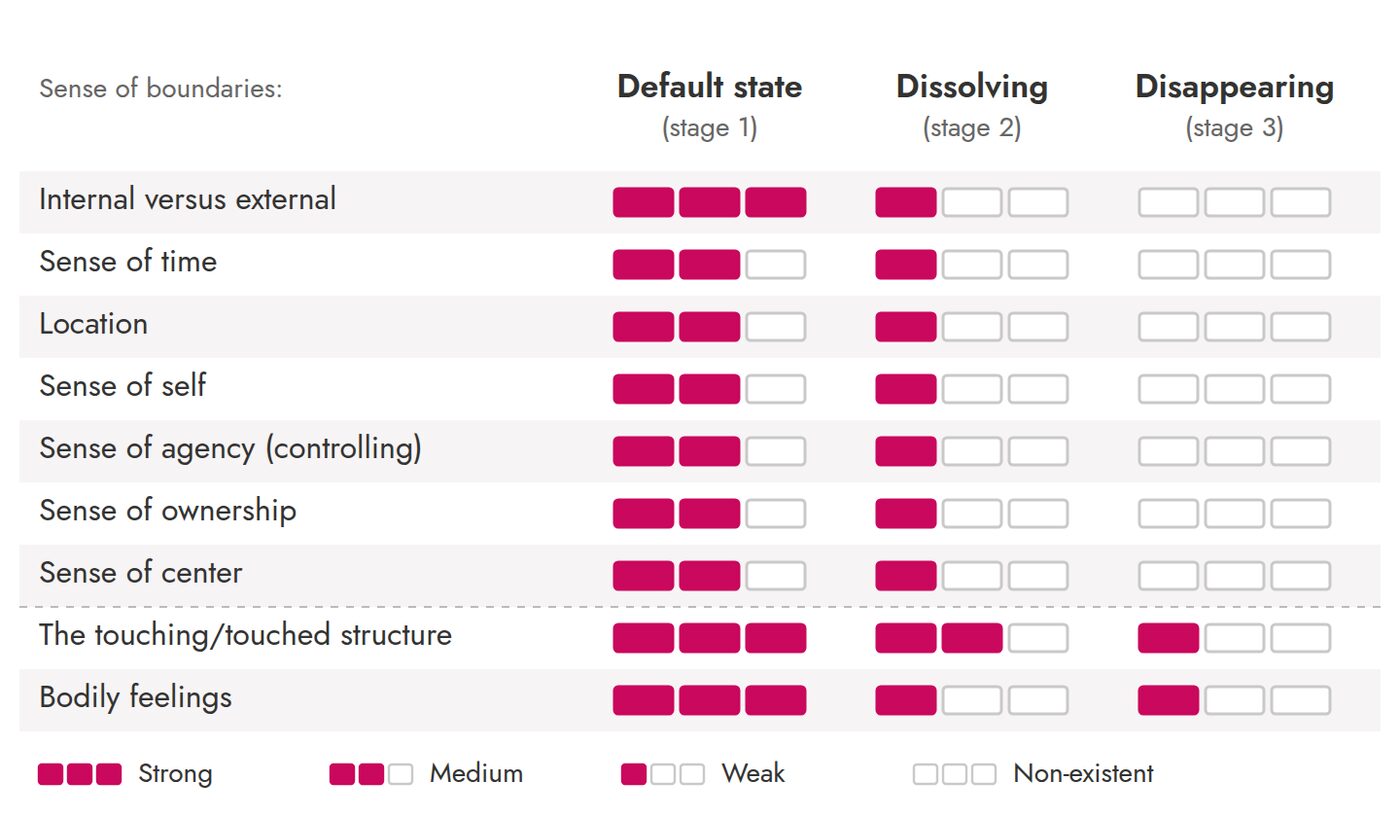
The ratings are a summary. The substance of the paper is S’s descriptions, stage by stage.
Stage 1: Located in a Body
S’s “default” was not an ordinary state of mind, and he said so: “my normal consciousness [default state] is no longer automatic about boundaries.” Still, in it he felt located somewhere, “floating inside the body’s boundaries,” with a clear sense of his hands touching each other and of where the cushion and ground touched his legs. He could tell near sounds from far ones. How sharp his boundaries were depended on his senses: “If I open my eyes then obviously the eyes have a huge amount of information and I know my boundaries exactly,” while “If I close my eyes then things get a little more uncertain.”
Stage 2: Made of Air
As the sense of boundaries began to dissolve, S described a “general sense of spaciousness such that the boundaries that are usual are not at all clear,” and “it’s like as if I’m in a way made of air and airiness extends out.” Sounds no longer came from outside: “the voices outside are kind of inside, I include them within the bubble.” Telling up from down, or left from right, now took effort. His sense of owning his body became “diluted,” and his sense of being at the center depended on attention: “If I put my attention out, then the center more or less disappears.” Looking closely at his touching hands pulled him back: “So if I really want to look at the way the hands touch each other, then I find myself back inside limited place.”
His sense of agency changed in a way he described vividly:
all movement happens by itself. All movement is spontaneous. Things are happening because they’re happening. They don’t need an agent. They’re happening by themselves. The right time comes and the leg moves.
Stage 3: Falling Into the World
In the third stage, S found the experience hard to describe: “it’s very difficult to talk from this place.” What he did describe was a sense of dropping:
sense of dropping, it’s like falling into empty space… I dissolve into the world and where you have the boundaries and the self as foreground and the world as background or as ground, here there isn’t a ground, there isn’t a foreground, in a way the background is everything, although not identical to the world, I’m not separate from background
There was no center and no location (“there’s really no address”), no personal point of view (“it’s like the world looking, not ME looking, the world is looking”), no sense of time (“time is not relevant anymore”), of control (“There is no sense of controlling”) or of ownership (“there is no sense of mine there is no sense of me”).
Yet not everything was gone. “I am not dead,” he said, “there is a kind of very light sense of body in this experience.” And something remained that was more than bodily feeling: “There’s still a witnessing happening and that witnessing is what’s left of me.” The authors wondered whether this was a faint split between a subject and an object, but that is not how S described it: “it’s like knowing it is happening without an object, or without a specific object.” The authors read this as a very thin form of the touching/touched structure, in which one is touching, and touched by, the whole world rather than any particular thing.
Miscellaneous Interesting Takeaways
Boundaries as Protection
S described the third stage in terms of need: “the feeling is that there is no need for any boundaries of any kind,” and “I am part of the world so there is no need for protection, there is no need for boundaries.” He also described “deep relaxation.” The authors take this as a clue that the sense of boundaries works like a protective shield. When people feel threatened, as in trauma, it can close rigidly (a link to
dissociation
Dissociation is a disruption in the usual integration of thoughts, feelings, perceptions, memory and sense of self. Mild forms, such as daydreaming or ‘zoning out’, are common. More marked forms include depersonalization (feeling detached from oneself), derealization (feeling that the world is unreal) and emotional numbing. Dissociation can be a response to stress or trauma and is a feature of several psychiatric conditions.
More on Wikipedia
Read more in the glossary
that draws on the first author’s earlier work); when they feel safe and at home in the world, it can loosen and even vanish. This is an interpretation of one man’s words, not something the study tested. It fits a later interview study of 46 meditators trained to dissolve the same boundary, in which relaxing and letting go, rather than effort, went with the deepest dissolution.
Inside and Outside as a Matter of Priority
S also rejected the idea that his boundary was simply a line between inside and outside. In the second stage, he said, “spaciousness becomes the priority instead of boundary.” The authors suggest that what feels “inside” may simply be what matters more to us. They sketch it as layers: what is me (my hand), what is mine but less part of me (like a prosthesis), and what is neither, though one can still control it (like a tool). In the third stage, S reported “no sense of priority” at all.
Agency and Ownership Came Apart
In S’s account, two feelings that philosophers distinguish behaved differently. His sense of agency, even in the default state, was mostly a sense that he could act: “I can theoretically move my hands if I want to.” His sense of ownership, by contrast, “doesn’t need decision,” but it was strengthened by movement: “If I move my hands it immediately confirms my sense of ownership.” The authors build on this to suggest a thin sense of agency based on the potential to act, and a sense of ownership that is continually confirmed by moving. They note that the second idea runs against lab research showing that ownership of a body part can be induced by sensory signals alone. These are proposals from one person’s reports, which the authors say need testing.
Did the Interview Shape the Words?
The authors cite S’s own view of the interview as a sign it worked: “It helped me to define and describe to myself and to others various dimensions of self-less awareness that I had not paid attention to before, such as the distinctions between agency and ownership.” That also cuts the other way. Agency, ownership, the “minimal self” and Merleau-Ponty’s touching/touched structure are concepts from the philosophy the first author works in, and S says the interview helped him draw distinctions he hadn’t drawn before. His own vocabulary, such as “witnessing” and “non-attachment,” comes from decades of Buddhist practice. None of this makes his reports untrue, but the nine categories are partly a joint product of an expert meditator, his tradition and his interviewers’ framework, not a neutral readout of experience.
Brain Data Offered Only as Background
To show that S was unusual, the methods section includes comparisons from the team’s earlier studies: his resting frontal
gamma
Gamma brain waves are a type of brainwave pattern that oscillate at approximately 25 to 100 Hz. Gamma waves are associated with states of heightened perception, problem-solving, and consciousness. Gamma waves play a crucial role in cognitive functioning, including memory, and information processing, and are thought to integrate thoughts and information from different parts of the brain.
More on Wikipedia
Read more in the glossary
activity differed from that of 12 non-meditators, and the brain changes when he let go of the sense of self were stronger than his group’s average. These are single-person comparisons, some offered “for illustration purposes,” and the statistics in that passage are hard to follow. The real test of his brain activity during these three stages came in the 2016 MEG paper, which found that
beta
Beta brain waves are a type of brainwave pattern that oscillate between approximately 12 to 30 Hz. Beta waves are typically associated with active thinking, focus, alertness, and engagement with the external world. They are prominent during conscious, goal-directed activity and are linked to cognitive tasks such as problem-solving, decision-making, and sustained attention.
More on Wikipedia
Read more in the glossary
waves weakened step by step as his boundaries dissolved, mostly in parietal regions tied to the sense of self and body.
Final Reflection
This paper does something unusual: it treats the testimony of an expert meditator as data and maps, in his own words, what is lost when the felt line between self and world disappears. The picture it draws is not of a single switch but of several strands loosening together: time, place, control, ownership and the sense of a center. A faint feel of the body, of touch, and of “witnessing” remained even at the end. That fits the argument, made in a review comparing meditation with psychedelics, that “self-loss” is not one thing. The map had uses beyond this paper: it guided the brain analysis of the same sessions and a later interview study that examined similar dimensions in 46 meditators.
The limits are plain, and the authors state them themselves:
It should be noted that this study has several limitations: (a) it is limited to one subject, (b) it is restricted to first-person data, (c) the subject studied (S) possesses unique abilities and it may be difficult, although not impossible with the right training, to replicate the results or draw from them conclusions regarding the general population, and (d) in the extreme state (the SB disappearing) even S has difficulty describing his inner experience.
To these one could add that the categories and their ratings came from the researchers’ reading of one man’s interview, without a reported check by a second analyst, and that S had a hand in designing the experiment. As a careful first-person description from someone unusually able to give one, it is a valuable starting point. It is not evidence of how common these experiences are, or of what dissolving the sense of boundaries is like for anyone else.
Citation
Ataria, Y., Dor-Ziderman, Y., & Berkovich-Ohana, A. (2015). How does it feel to lack a sense of boundaries? A case study of a long-term mindfulness meditator. Consciousness and Cognition, 37, 133–147. 10.1016/j.concog.2015.09.002
Get the next summary by email
One or two new paper summaries every couple of weeks, sent to your inbox when they go up.
No spam, and you can unsubscribe at any time. Prefer a feed reader? Use the RSS feed.