
Background Information
How often does meditation cause problems? The answer depends a great deal on how and whom you ask. In a US survey led by Simon Goldberg, 32% of people who had tried meditation said it had led to a challenging or distressing experience at some point, and 50% ticked at least one item on a checklist of specific effects. When an interviewer asked participants in an 8-week mindfulness course about 44 specific experiences, 58% reported at least one that felt unpleasant at the time. And about a quarter of regular meditators said they had had a particularly unpleasant experience they thought meditation may have caused.
All of these studies counted
meditation-related adverse effects
Meditation-related adverse effects are unpleasant experiences that a person attributes to meditation practice, ranging from mild and brief to severe and lasting. Examples include anxiety, re-living traumatic memories, trouble sleeping and feeling disconnected from oneself or the world. Researchers usually record how long each effect lasted and whether it interfered with daily functioning.
Read more in the glossary
among people who meditated. None compared them with a group of similar people who did something else, so none could say how much of what they counted would have happened anyway. People feel anxious, low or upset during ordinary days too. A randomly assigned comparison group supplies that missing baseline.
This study, led by Otto Simonsson of the Karolinska Institutet with Goldberg among the co-authors, builds that comparison into a large online experiment. The authors note that earlier randomized trials that counted adverse experiences had not used nationally representative samples or compared different kinds of meditation. Many programs also bundle several practices together, which makes it hard to tell which one is responsible for a problem. So the team tested single, brief sessions of three common practices against an everyday alternative: using the internet. Short guided sessions like these are a widely used format in classrooms, clinics and meditation apps.
What They Did
In November and December 2023, the researchers recruited adults in the US and the UK through Prolific, an online research platform, using its option to match each country’s adult population by age, sex and ethnicity. The study took about 25 minutes and paid US $3.20. Of 5,260 people who took part, 155 were excluded for failing an attention check and 56 for incomplete answers, leaving 5,049 who were randomly assigned.
Before the session, everyone filled in a long set of questionnaires: demographics, personality, anxiety, depression, stress, loneliness, current mood, mindfulness,
self-compassion
Self-compassion means treating yourself with the kindness you would offer a friend when you fail or suffer. In psychologist Kristin Neff’s widely used definition it has three parts: kindness toward oneself rather than harsh judgment, seeing one’s difficulties as part of shared human experience rather than as isolating, and mindful awareness of painful feelings without being swept away by them. It is usually measured with Neff’s Self-Compassion Scale.
More on Wikipedia
Read more in the glossary
, gratitude, past meditation practice and use of the internet and apps for mental health.
The experiment used a
factorial design
A factorial design is an experiment that tests several factors at once by randomly assigning people to every combination of them. A study crossing three practices with two session lengths, for example, has six groups. Each factor’s effect can then be estimated from the whole sample rather than from a separate experiment, and researchers can check for interactions, where the effect of one factor depends on the level of another.
More on Wikipedia
Read more in the glossary
, crossing three factors at once:
- Practice: a guided
mindfulness
Mindfulness is the psychological process of purposely bringing one’s attention to experiences occurring in the present moment without judgment. It involves maintaining awareness of thoughts, feelings, bodily sensations, and surrounding environment with an attitude of curiosity and acceptance. In meditation contexts, mindfulness practices typically involve focusing attention on the breath or body sensations as anchors to the present moment while acknowledging and releasing distracting thoughts.
More on Wikipedia
Read more in the glossary meditation (paying attention to the present moment without judgment), a self-compassion meditation (generating kindness and friendliness toward oneself), a gratitude meditation (generating gratitude and appreciation), or the control condition, using the internet as one normally does. - Length: 5 or 10 minutes.
- Narrator’s voice: male or female (meditation groups only).
That made 14 conditions, with about 1,260 people in each of the four practice groups. The recordings came from the Healthy Minds Program app. The page would not let anyone move on until the full 5 or 10 minutes had passed, and afterward a check question asked people what they had been told to do.
The researchers measured adverse experiences in two ways. The first was a single yes/no question asked right after the session: “Did you have a distressing experience during the task you just completed?” Earlier studies often asked about “challenging, difficult, or distressing” experiences, and the authors deliberately narrowed it:
…the use of multiple qualifiers (ie, “challenging,” “difficult,” and “distressing”) complicates interpretation and reduces measurement precision—many activities may be challenging or difficult (eg, learning to play the violin or swimming) but would typically not be considered adverse experiences simply for that reason.
They acknowledge that this makes their numbers less directly comparable with studies that asked the broader question. The second measure was a clinically relevant rise in negative mood: an increase on the negative-feelings scale of the
PANAS
The Positive and Negative Affect Schedule (PANAS) is a widely used questionnaire with two short lists of feeling words, one for positive feelings and one for negative ones. People rate how strongly they feel each, and the ratings are added up into separate positive affect and negative affect scores, each from 10 to 50. The two scores are largely independent of each other, and when it asks about the present moment it can be given just before and just after a single session.
More on Wikipedia
Read more in the glossary
from before to after the session, above a threshold (0.24 standard deviations) the authors took from depression research.
These were secondary outcomes of a larger trial, and the comparison between groups was preregistered as exploratory. Because there were two outcomes, the team lowered the bar for statistical significance to p < .025 to allow for
multiple comparisons
The multiple comparisons problem arises when researchers run many statistical tests at once. Each test has a small chance of a false positive, so across thousands of tests, such as one for every point in a brain scan, some “significant” results will turn up by chance alone. Corrections raise the bar for significance to keep the overall false-positive rate down, at the cost of making small real effects harder to detect.
More on Wikipedia
Read more in the glossary
. They report that, with this many people, the study had at least 80%
power
Statistical power is the chance that a study will detect an effect of a given size if that effect is real. It rises with the number of participants and with the size of the effect: a small study may have good power to detect a large effect but little power to detect a modest one. A study with low power can miss a real effect, so a non-significant result from it is weak evidence that no effect exists.
More on Wikipedia
Read more in the glossary
to detect an
odds ratio
An odds ratio compares the odds of an outcome in one group with the odds in another, where the odds are the chance something happens divided by the chance it doesn’t. An odds ratio of 1 means no difference, above 1 means higher odds in the first group, and below 1 lower odds. When an outcome is common, an odds ratio looks bigger than the difference in percentages: 30% versus 20% is an odds ratio of about 1.7.
More on Wikipedia
Read more in the glossary
of 1.55 or more for distressing experiences and 1.40 or more for rises in negative mood.
One Big Result: Meditating Was No More Distressing Than Using the Internet
Across everyone, 4.1% (204 of 4,925) said they had a distressing experience during their task, and 7.1% (348 of 4,908) had a clinically relevant rise in negative mood. The key comparison is between the groups:
- Distressing experience: 4.0% in the internet group, against 4.8% after gratitude, 3.7% after self-compassion and 4.0% after mindfulness. Taken together, people who meditated were no more likely to report distress than people who used the internet (odds ratio 1.05, 95%
confidence interval
A confidence interval is the range of values that a study’s data are consistent with, given the uncertainty that comes from measuring a limited sample. A 95% confidence interval for an effect of 0.30 running from 0.00 to 0.59, for example, means the true effect could plausibly be anywhere from nothing to moderate. Narrower intervals mean more precise estimates; an interval that includes zero means the study can’t rule out no effect.
More on Wikipedia
Read more in the glossary 0.76–1.47, p = .76). - Rise in negative mood: 9.6% in the internet group, against 5.9–6.8% in the three meditation groups. People who meditated were less likely to have a marked rise in negative mood (odds ratio 0.63, 95% CI 0.50–0.80, p < .001).
The three practices did not differ from one another on either measure.
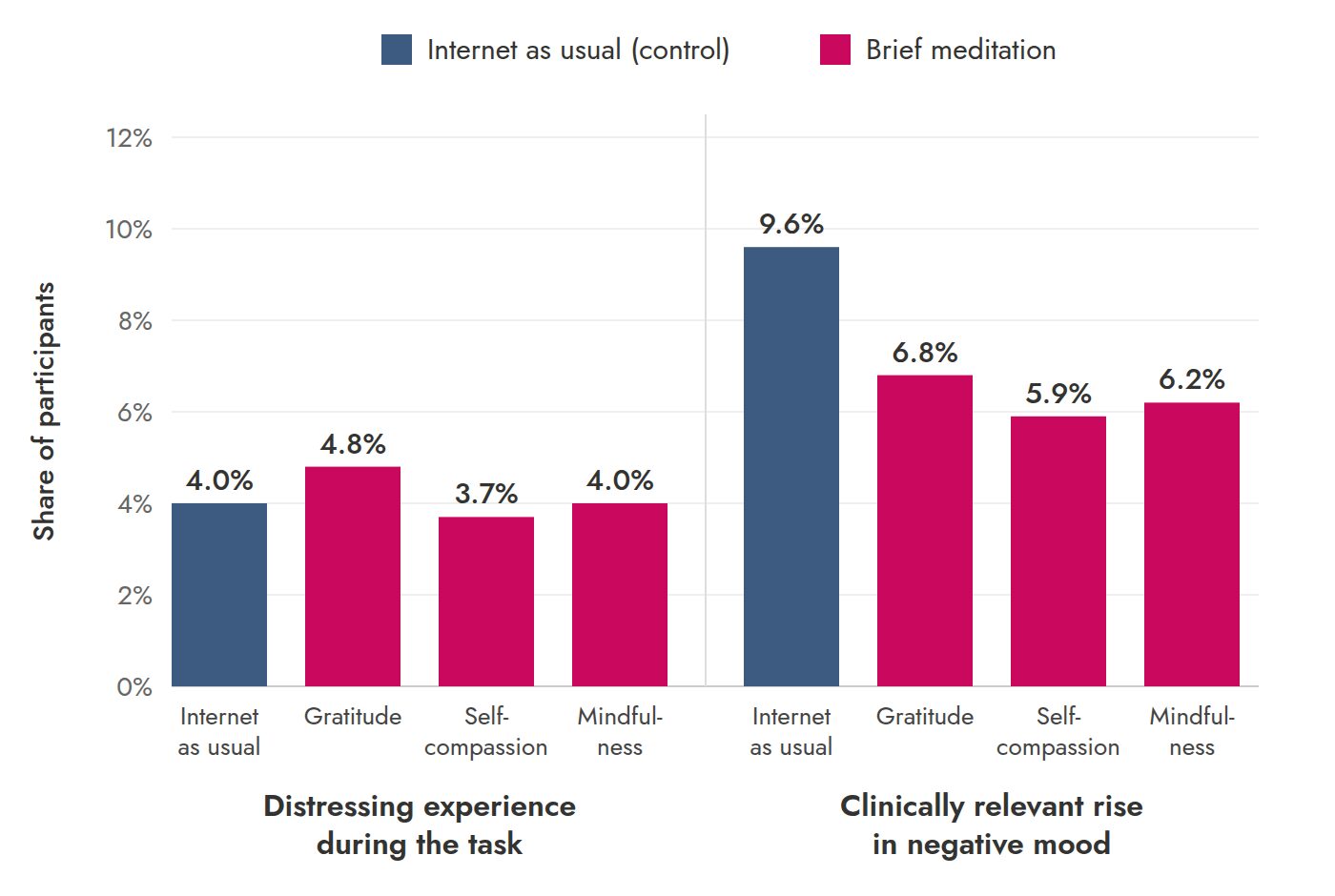
This is what the randomized design adds. On its own, “4% of people found a brief meditation distressing” would read as a measure of meditation’s risk. With a comparison group, it turns out that about 4% of people answer yes to that question after 5 or 10 minutes online, too. The authors conclude:
Taken together, the findings suggest that the brief, digitally delivered meditation practices tested in this study carry risks of adverse experiences that are comparable to or lower than those of typical activities on the internet…
The comparison is against ordinary internet use, not against sitting quietly or a neutral task, and what people actually did online wasn’t recorded. The authors point out what that might mean:
It is therefore plausible that at least some participants spent their allocated 5- or 10-minute window engaging with emotionally activating material (eg, news coverage and social media), any of which may itself have elicited distressing experiences or increases in negative affect.
So the finding is that a short meditation carried about the same risk of distress as a realistic alternative way to spend those minutes. It doesn’t show that meditation carries no risk at all. The power figures above also matter: the study was large enough to detect a sizable increase in distress after meditation, but a small one could have been missed.
Miscellaneous Interesting Takeaways
Ten Minutes Brought a Little More Distress Than Five, in Every Group
People assigned to 10 minutes reported a distressing experience more often than people assigned to 5 minutes (4.8% vs 3.5%; odds ratio 1.42, 95% CI 1.07–1.89, p = .02). The authors read this as a sign that “a higher single dose may increase the incidence of distressing experiences.” Note, though, that this comparison pooled all four groups, internet users included, and the test of whether the length effect differed between meditation and internet use was not significant. As the paper reports it, longer sessions went with slightly more distress whatever people were doing, and the data don’t show that the effect was specific to meditation. The authors also caution that a sample with little meditation experience, and a step from 5 to 10 minutes, say little about experienced meditators or much longer sessions.
Session length made no difference to rises in negative mood overall. Answers were also missing about twice as often in the 10-minute groups (for example, 3.5% vs 1.4% for the distress question), in meditation and internet groups alike, which the authors attribute to the longer task rather than to people dropping out because they were upset.
The Narrator’s Voice Didn’t Matter
Whether the meditation was read by a man or a woman made no significant difference to either outcome (odds ratios 0.94 and 0.86). The authors had tested this because studies of meditation teachers and of psychotherapists suggest that who is guiding a person can shape how they fare.
Who Reported Distress Could Be Partly Predicted
The team trained two kinds of machine-learning model on everyone’s baseline answers to see whether they could predict who would have an adverse experience, checking each model on data it had not been trained on. The better one (elastic net, a form of regression that keeps only the most useful predictors) reached an area under the
ROC curve
A receiver operating characteristic (ROC) curve shows how well a test or prediction model separates people who have an outcome from people who don’t. The area under it (AUC) sums this up as one number: 0.5 means the model does no better than a coin toss, and 1.0 means it sorts everyone correctly. An AUC of 0.7 means that if you pick one person with the outcome and one without, the model ranks the first as higher risk 70% of the time. Values around 0.7 to 0.8 are usually called acceptable, not strong.
More on Wikipedia
Read more in the glossary
(
AUC
The area under the curve (AUC) sums up a series of measurements taken over time as a single number: plot the level of, say, a hormone at each sample, join the points, and measure the area beneath the line. Stress researchers often use a version calculated with respect to increase, which counts only the rise above the first sample, so it reflects how strongly and for how long a level rose during a stressful task.
More on Wikipedia
Read more in the glossary
) of 0.73 for distressing experiences, which the authors call acceptable, and 0.67 for rises in negative mood, which falls in the range they call poor.
The strongest predictors of a distressing experience were feeling negative just before the session, more experiences of discrimination, identifying as transgender, higher anxiety and higher depression. Identifying as Black was also among the top predictors. For rises in negative mood, higher gratitude and a less judgmental attitude toward one’s own experience were protective, as was being assigned to the mindfulness or self-compassion meditation. The finding that current anxiety and depression went with more distress echoes the 2022 survey, where people with more depression and anxiety reported more adverse effects.
The authors suggest that these results should inform how meditation is offered to people dealing with stress related to their identity. Two points temper this. The models were built on the whole sample, including the internet group, and group assignment carried little weight in predicting distress, so they describe who tended to report distress during a short online task rather than during meditation in particular. And the models were not tested in a separate sample, which the authors list as a limitation.
Why 4% Here and 25–58% Elsewhere?
The rates in this study are far lower than those in the surveys and course studies elsewhere on this site, but they answer a different question. Those studies asked about months or years of practice, or about an 8-week course with daily home practice. This one asked about a single 5- or 10-minute session, right after it ended, with one yes/no question about distress only. The Britton course study found that a single broad question picked up only about a third of the people who reported effects when asked about specific experiences. The authors acknowledge that their estimates could be lower bounds of the true rate.
What the Study Can’t Say
The authors list several limits. Both outcomes were self-reported, and the distress measure was a single item rather than a validated checklist. Effects were measured only during and right after the session, so nothing is known about how long they lasted or whether any appeared later. The sample was matched to the US and UK populations only on age, sex and ethnicity, and it was recruited from an online research platform. One attention check was the only screen for careless answers. The paper’s conflict-of-interest statement says that Simonsson is a cofounder of embla.ai AB and received a one-time payment from Mindfully Sweden AB for educational content.
Final Reflection
Most research on meditation’s downsides counts how often meditators report problems. This trial asks a different question: how much more often than people who spent the same few minutes doing something else? For a single short guided meditation, the answer was not more often for distress, and less often for a marked dip in mood. That is reassuring for the many people who try a brief practice in an app, a classroom or a clinic.
It doesn’t cancel out the higher rates found elsewhere in this theme. A one-off 5-minute recording is not an 8-week course, a silent retreat or years of daily practice, and a single yes/no question asked immediately cannot capture effects that build up or appear later. The study’s lasting contribution may be its design. Randomized comparisons like this one, applied to longer and more intensive practice, are what it would take to say how much of meditation’s reported difficulty is caused by meditation itself.
Citation
Simonsson, O., Jiwani, Z., Ruiz, M., Narayanan, J., Osika, W., Hirshberg, M. J., & Goldberg, S. B. (2026). Adverse experiences in brief meditation practices: Randomized controlled trial. JMIR Mental Health, 13, e95628. 10.2196/95628
Get the next summary by email
One or two new paper summaries every couple of weeks, sent to your inbox when they go up.
No spam, and you can unsubscribe at any time. Prefer a feed reader? Use the RSS feed.