
Background Information
Meditation is widely recommended for stress and mental health, and the authors note that during the COVID-19 pandemic several agencies encouraged it as a way of coping. Studies of
meditation-related adverse effects
Meditation-related adverse effects are unpleasant experiences that a person attributes to meditation practice, ranging from mild and brief to severe and lasting. Examples include anxiety, re-living traumatic memories, trouble sleeping and feeling disconnected from oneself or the world. Researchers usually record how long each effect lasted and whether it interfered with daily functioning.
Read more in the glossary
have found that difficult experiences, mostly brief anxiety and similar effects, are fairly common. At the far end of that range is
psychosis
Psychosis is a state in which a person loses touch with reality in important ways, most often through hallucinations (perceiving things that aren’t there, such as hearing voices) and delusions (fixed false beliefs, such as being persecuted). It is a feature of several conditions, including schizophrenia, bipolar disorder and severe depression, and can also be brought on by drugs, extreme sleep loss or physical illness. It is usually treated with antipsychotic medication and psychological support.
More on Wikipedia
Read more in the glossary
: losing touch with reality through hallucinations or delusions. Here the literature, the authors write, “is scarce in this area and limited to a few case reports or reviews.”
Deepak Charan, Snehil Gupta and colleagues, psychiatrists in India and Nepal, set out to add to that record. They describe five patients whose psychosis began after a period of intense meditation, look for what the cases had in common, and offer recommendations for screening and supervising meditators. They also point to the traditions themselves: the Yoga Sutras of Patanjali advise that practice proceed slowly and in steps, and chapter VI of the Gita counsels moderation in food and sleep. The authors suggest that ignoring such guidance can contribute to adverse effects.
What They Did
This is a
case series
A case series describes a small group of patients who share an exposure or an illness, such as people who became unwell after a particular practice, usually drawn from clinicians’ own work. It can flag a possible link and suggest ideas to test, but with no comparison group and no count of how many people had the same exposure without becoming ill, it can’t show cause or how common the outcome is.
More on Wikipedia
Read more in the glossary
: a description of a handful of patients, not an experiment. The five patients came from three places in India and one in Nepal; three were treated as outpatients and two in hospital. The team wrote up each case following the CARE guidelines for case reports, and the patients or their legal representatives gave written consent for publication.
All five were women, aged 52, 46, 40, 22 and 20. None had a history of psychiatric illness. Two had a family history of severe mental illness: the mother of one (who did a similar practice herself) and a second-degree relative of another. The youngest also had a birth history of hypoxic-ischemic encephalopathy, brain injury from a lack of oxygen.
All five practiced
concentrative
Focused attention is a style of meditation in which you keep your attention on one chosen object, such as the breath or a point in front of you, notice when the mind has wandered, and bring it back. It trains steady concentration, and Buddhist shamatha practice is a well-known example. Researchers often contrast it with open monitoring meditation.
Read more in the glossary
meditation, focusing on a single object. One also practiced what the paper calls a “transcendental type”, and another combined concentration with
open monitoring
Open monitoring is a style of meditation in which attention isn’t fixed on any one object. You stay aware of whatever arises from moment to moment, such as sounds, sensations and thoughts, and let each come and go without reacting to it, holding on to it or pushing it away. Researchers often contrast it with focused attention meditation.
Read more in the glossary
. Case 4’s practice involved focusing on a point while listening to chants or
mantras
A mantra is a sound, word or phrase that is repeated, aloud or silently, as a spiritual or meditative practice. Mantras are central to Hindu and Buddhist traditions and appear in many others. In mantra meditation, the repetition itself serves as the object of attention, and practitioners often describe it as calming.
More on Wikipedia
Read more in the glossary
through headphones.
For each patient the team recorded the history from the patient and family, a mental state examination, blood tests (blood count, kidney, liver and thyroid function) and, in four cases, a CT scan of the head; the youngest also had an
EEG
An electroencephalogram (EEG) is a recording of brain activity. During this painless test, small sensors are attached to the scalp to pick up the electrical signals produced by the brain.
More on Wikipedia
Read more in the glossary
. All the tests were within normal limits.
One Big Result: Psychosis Followed a Sudden Step Up in Practice
The pattern the authors highlight is a sudden change in how much people meditated. Three of the women had meditated for one to five years, at 1–4 hours a day, before increasing sharply. The other two developed symptoms within ten days of starting meditation.
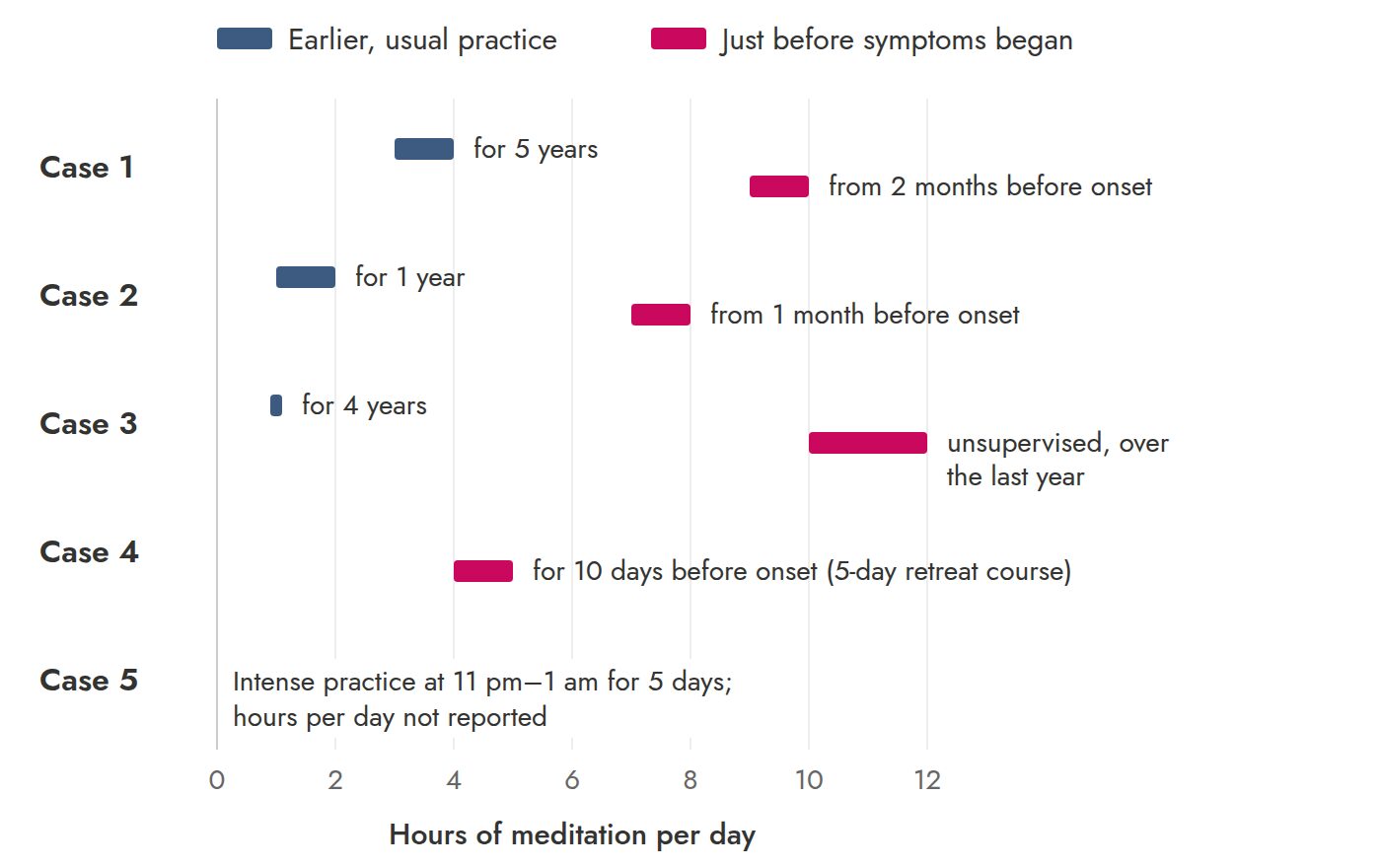
- Case 1, aged 52, had practiced 3–4 hours a day for five years, rising to 9–10 hours a day two months before her illness began. She developed low mood, poor sleep and appetite, hallucinations and catatonic symptoms (not speaking, holding fixed postures) and was diagnosed with a severe depressive episode with psychotic symptoms.
- Case 2, 46, had practiced 1–2 hours a day for a year, rising to 7–8 hours a day a month before onset. She withdrew socially, wandered aimlessly and showed hallucinatory behavior (unspecified nonorganic psychosis).
- Case 3, 40, had meditated an hour a day for four years, then 10–12 hours a day, unsupervised, for the past year. She heard voices, including commanding ones, and was diagnosed with paranoid schizophrenia.
- Case 4, 22, meditated 4–5 hours a day for ten days, including a five-day retreat course. Her illness began abruptly, with fear, simple auditory hallucinations, visual distortions, irrelevant speech and delusions of persecution and reference (acute and transient psychotic disorder).
- Case 5, 20, meditated intensely between 11 pm and 1 am for five days in a row. She heard voices and had delusions of persecution and reference, believing that others meant her harm or that events referred to her (paranoid schizophrenia).
The authors are careful about what this shows:
Although an unequivocal temporality between the two, particularly among those cases with a history of meditation practice for a significant period, could not be firmly established, a marked change in their pattern of meditation was observed.
In other words, they can’t be sure the meditation came first, let alone that it caused the illness, especially for the three women who had meditated for years. What they saw was a sharp change in practice shortly before symptoms appeared, which they read as an association, one that has also been reported in earlier literature.
How the Patients Fared
All five were treated with an antipsychotic (olanzapine in every case, with other medicines in some) and advised to stop deep meditation. Case 1 recovered, came off medication and had been well for six months, no longer meditating. Case 2 was well six months later on medication, also not meditating. Case 3 improved, though some delusions persisted. Case 4 improved, but when she restarted meditation two months later her symptoms returned; her dose was raised, she was asked to stop meditating, and she had been well for six months. Case 5 had no remaining symptoms.
Because treatment and stopping meditation happened together, the cases can’t separate their effects. The relapse in Case 4 after she resumed practice is the observation that most directly links meditation to symptoms, and it is a single case.
Miscellaneous Interesting Takeaways
Spiritual Experience or Illness?
For Case 1, the authors note a diagnostic challenge: within her spiritual community, some followers would have seen her state as part of a deep meditative experience, while others would have called it abnormal. The clinicians labeled it a disorder because she could no longer function socially, at work or in caring for herself. Two of the women spoke of their practice as “Seva” (service), and Case 3 said she meditated to deepen her connection with God, with whom she was able to converse. Case 4 reported seeing flashes of light while meditating. Lights are a fairly common meditation experience in their own right: 9 of 28 Buddhist practitioners in Lindahl and colleagues’ interviews described them.
Practicing Alone, With No One Checking In
The authors report that all five patients were meditating deeply without being in touch with an instructor, and none contacted their teacher when unusual experiences began. Neither family history had been recorded by the yoga instructor before the patients joined their programs. In one case, the authors add, the patient took up meditation to improve her attention and concentration for her studies, while the program she joined aimed at attaining a deeper state of consciousness. They suggest this mismatch, with too little assessment of how prepared she was, may have contributed.
A Risk List Drawn Mostly From Earlier Reports
The paper’s table of possible risk factors includes a family history of psychosis, odd or eccentric personality traits, long practice (especially for beginners), practicing at odd hours, fasting, dehydration and sleep loss, isolation, unsupervised practice, concentrative or transcendental styles, and a sudden increase in practice. But it is not a finding of this study:
developed by the authors based on the available literature on meditation and psychosis and not merely on the current case-series.
Their recommendations are drawn from the literature in the same way. They include asking about personal and family psychiatric history before people join a meditation program; starting beginners and vulnerable people on lighter guided or open monitoring practice; supervising at-risk practitioners and encouraging group sessions, where unusual experiences are more likely to be noticed; not combining meditation with restricted sleep, food or water; asking about sudden changes in practice; and stopping meditation if psychosis begins. After recovery, they advise not resuming, or doing so only in short, supervised sessions while staying on medication.
Five cases can’t test any of these. The cases themselves don’t sort neatly by style either: Case 5 combined concentration with open monitoring, one of the styles the authors suggest for vulnerable beginners. Some mainstream programs already screen in this way: in Britton and colleagues’ mindfulness course study, people with a history of psychosis were excluded, following standard guidelines.
What the Authors Couldn’t Check
The authors list their limitations plainly:
First, the temporality between meditation with psychosis cannot be proven without doubt. Second, corroborative information from the meditation trainer/expert was not available; hence, the information presented is solely based on the patients’ and caregivers’ versions.
They add that the possible contributions of starvation and dehydration were not assessed, and that only the short- to medium-term course is known.
Final Reflection
This paper documents the severe end of meditation’s possible harms, which surveys of everyday meditators rarely capture. The surveys on this site find that difficult experiences are common but mostly mild and brief: about half of US adults who had tried meditation reported at least one adverse effect on a checklist, and about 1 in 10 said one had interfered with daily life (Goldberg et al., 2022); in an online survey, 25.4% of meditators reported an unwanted effect, most often anxiety, and most who described theirs called it temporary (Cebolla et al., 2017). The case series itself agrees that such effects are usually brief and improve with changes in practice or with treatment.
A case series can’t say how often psychosis follows meditation, or whether meditation caused it in these five women rather than coinciding with an illness that was already developing. Two had a family history of severe mental illness, and in several cases the practice also involved very long hours, late nights or little supervision. What the cases do show is a recognizable pattern, a sudden escalation of intense, unsupervised practice shortly before symptoms, along with recovery with treatment and one relapse on resuming. That supports the authors’ practical message: ask about psychiatric history, increase practice gradually, keep practitioners connected to a teacher or group, and take abrupt changes in someone’s practice seriously.
Citation
Charan, D., Sharma, P., Kachhawaha, G., Kaur, G., & Gupta, S. (2023). Meditation practices and the onset of psychosis: A case series and analysis of possible risk factors. Indian Journal of Psychological Medicine, 45(1), 80–84. 10.1177/02537176211059457
Get the next summary by email
One or two new paper summaries every couple of weeks, sent to your inbox when they go up.
No spam, and you can unsubscribe at any time. Prefer a feed reader? Use the RSS feed.