
Background Information
Insomnia symptoms are common, and they don’t stay in the bedroom: people who sleep badly are often tired, sleepy and less productive during the day. The recommended first treatment for insomnia is
cognitive behavioral therapy for insomnia (CBT-I)
Cognitive behavioral therapy for insomnia (CBT-I) is a structured, usually short-term talk therapy for chronic sleeplessness. It combines changes to sleep habits and schedules, such as limiting time in bed, with work on unhelpful thoughts about sleep. It is widely recommended as a first-line treatment for insomnia.
More on Wikipedia
Read more in the glossary
, which works well and lasts, but the authors note it is intensive, costly and hard to find, because it needs specialized therapists.
Mindfulness
Mindfulness is the psychological process of purposely bringing one’s attention to experiences occurring in the present moment without judgment. It involves maintaining awareness of thoughts, feelings, bodily sensations, and surrounding environment with an attitude of curiosity and acceptance. In meditation contexts, mindfulness practices typically involve focusing attention on the breath or body sensations as anchors to the present moment while acknowledging and releasing distracting thoughts.
More on Wikipedia
Read more in the glossary
programs had become a promising alternative. A meta-analysis of 18 randomized trials found that they improved self-reported sleep quality more than time-matched classes, and in a trial in older adults, a six-week mindfulness course improved sleep more than
sleep hygiene
Sleep hygiene is a set of everyday habits and conditions thought to support good sleep, such as keeping regular sleep and wake times, limiting caffeine, alcohol and screens before bed, and keeping the bedroom dark, quiet and cool. Sleep hygiene advice is a common part of insomnia treatment, but on its own it usually helps less than structured therapies such as CBT-I.
More on Wikipedia
Read more in the glossary
classes. But those programs were taught in person. Meanwhile, millions of people were already trying to meditate their way to sleep with phone apps. The authors cite a survey of more than 11,000 Calm users in which 62.9% said they had downloaded it to improve their sleep, and they point out that no meditation app had yet been tested for sleep problems in a
randomized controlled trial
A Randomized Controlled Trial is a scientific study design that randomly assigns participants to either an experimental group receiving an intervention or a control group, allowing researchers to measure the true effect of the intervention while minimizing bias.
More on Wikipedia
Read more in the glossary
.
So they tested Calm, as people actually use it, in adults with disturbed sleep. They chose fatigue as the main outcome because it is one of the most frequent complaints of people with insomnia.
What They Did
Between June and September 2019, the team recruited adults across the US through social media, email lists and the ResearchMatch website, advertising a “mobile app intervention for physical and mental health.” To join, people needed at least moderate insomnia symptoms, a score above 10 on the Insomnia Severity Index (a cutoff the authors chose because it is good at detecting at least subthreshold insomnia in the general population). They also had to have meditated no more than 60 minutes a month in the previous six months. Everything happened online.
The 263 people who completed the first questionnaires were randomly assigned, one by one, to two groups:
- Calm app (124 people): eight weeks of free access to the app, with instructions to meditate for at least 10 minutes a day and to use it as much as they liked. Calm offers guided meditations, which the paper describes as grounded in
Mindfulness-Based Stress Reduction (MBSR)
Mindfulness-Based Stress Reduction (MBSR) is a program designed to help individuals cope with stress, pain, and illness. Developed by Jon Kabat-Zinn in the 1970s, it combines meditation and yoga to promote awareness and stress management. The eight-week program teaches participants to focus on the present moment non-judgmentally, enhancing their ability to manage difficulties.
More on Wikipedia
Read more in the glossary and Vipassana Vipassana is a form of Buddhist meditation focused on the cultivation of insight through moment-to-moment awareness of bodily sensations, thoughts, and emotions. It emphasizes non-reactivity and equanimity, helping practitioners observe mental and physical phenomena without attachment.
More on Wikipedia
Read more in the glossary meditation, plus sleep-specific meditations and “Sleep Stories.” The team suggested starting with the app’s “7-Days of Calm” introduction, but people could choose whatever they wanted, to mirror how a new paying member would use it. - Wait-list (139 people): a
wait-list control group
A wait-list control group is a comparison group that receives the program being studied only after the study period, so participants who are waiting can be compared with those already taking part. It controls for the passage of time and repeated testing, but not for the attention, expectations and setting that come with taking part in any program, which an active control group can address.
More on Wikipedia
Read more in the glossary , asked to carry on as normal and not to use any apps for relaxation, meditation or sleep. After eight weeks they got the same free access to Calm.
Participants were on average 44.5 years old; 75% were women, 70% had a college degree and 58% were white. About 41% reported having been diagnosed with a sleep-related condition, most often insomnia (25%) or sleep apnea (16%).
Both groups filled in three questionnaires at the start, after four weeks and after eight weeks:
- the Fatigue Severity Scale, nine statements about how fatigue affects daily life, averaged to a score from 1 to 7 (the main outcome);
- the
Epworth Sleepiness Scale
The Epworth Sleepiness Scale is a short questionnaire that measures daytime sleepiness. People rate how likely they would be to doze off in eight everyday situations, such as reading, watching TV or sitting in a stopped car in traffic, from 0 (would never doze) to 3 (high chance of dozing). The total runs from 0 to 24, with higher scores meaning sleepier days.
More on Wikipedia
Read more in the glossary , how likely people are to doze off in eight everyday situations (0 to 24); - the Pre-Sleep Arousal Scale, which has two parts: cognitive arousal, such as intrusive thoughts while trying to fall asleep, and somatic arousal, bodily signs such as sweating (each 8 to 40).
The app group also kept a daily
sleep diary
A sleep diary is a daily log, usually filled in each morning, of when a person went to bed, how long it took to fall asleep, how often they woke in the night, when they got up and how well they felt they slept. It is a standard way to track sleep over weeks, but because it relies on people’s own estimates it can differ from sleep measured with recording devices such as polysomnography or wrist-worn activity monitors.
More on Wikipedia
Read more in the glossary
, including a 1–5 rating of how well they had slept. The wait-list group did not keep one, because the authors worried that tracking sleep can itself change behavior. Calm supplied logs of each participant’s app use.
One Big Result: App Users Felt Less Sleepy and Less Keyed Up at Bedtime
In
intention-to-treat analyses
An intention-to-treat analysis counts every randomized participant in the group they were assigned to, whether or not they completed or even started the treatment. It keeps the benefit of randomization, since dropping people who didn’t follow their plan can leave groups that differ in other ways, and it estimates what happens when a treatment is offered in practice rather than when it is taken exactly as intended.
More on Wikipedia
Read more in the glossary
(an analysis of only those who stuck with the study gave similar results for fatigue), the app group improved more than the wait-list group on all four questionnaire measures. The two groups started out with nearly identical scores, and on bedtime arousal the gap opened up within the first four weeks:
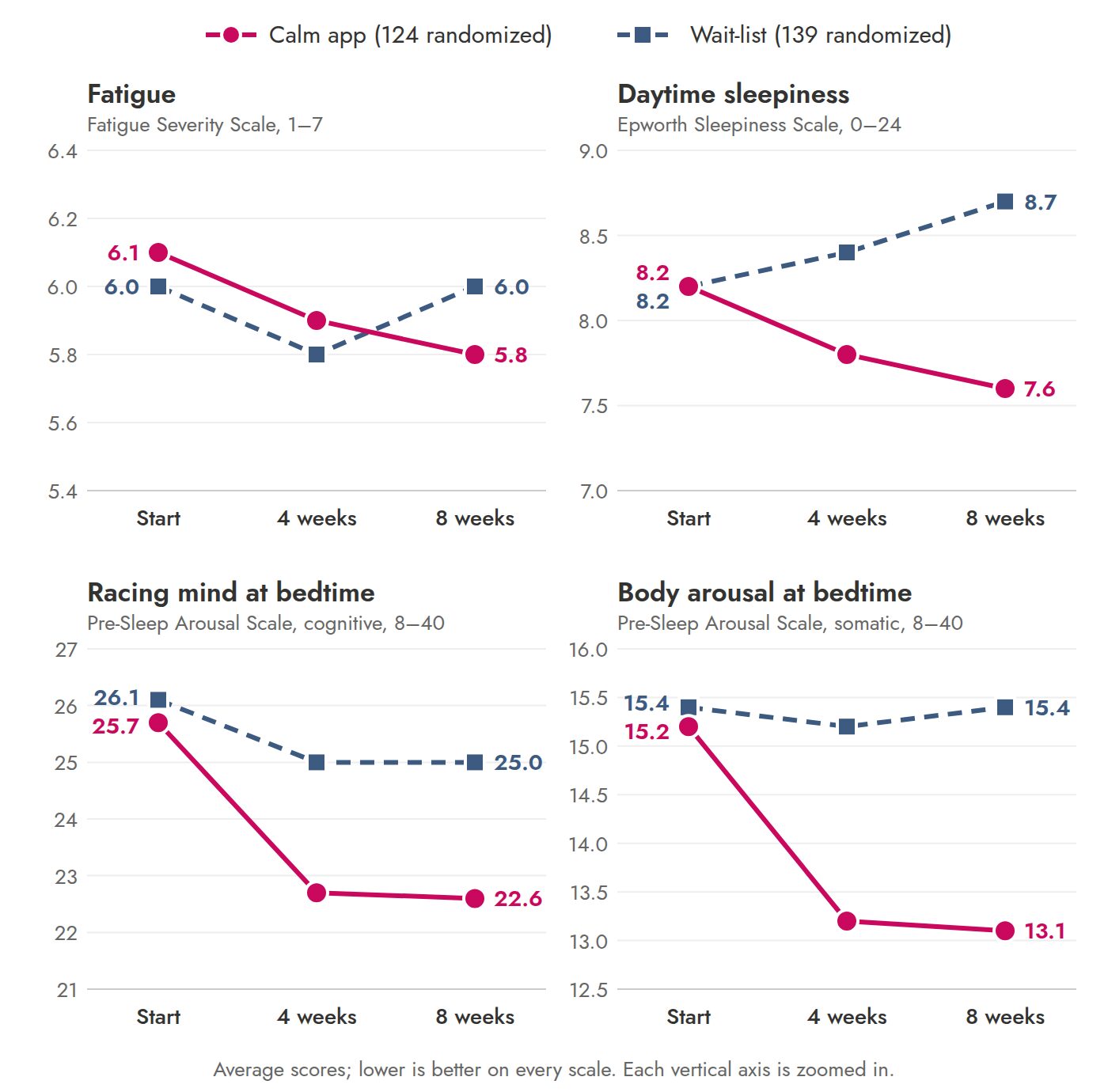
- Bodily arousal at bedtime showed the clearest difference: the app group’s score fell from 15.2 to 13.1 while the wait-list group’s stayed at about 15 (
effect size
Effect size is a statistical concept that quantifies the magnitude or strength of a relationship, difference, or intervention outcome. Unlike p-values which only indicate statistical significance, effect sizes measure how meaningful a result is in practical terms. Common measures include Cohen’s d (standardized mean difference), correlation coefficients (r), and odds ratios. In meditation research, effect sizes help quantify the practical impact of different meditation practices on psychological or physiological outcomes.
More on Wikipedia
Read more in the glossary d = 0.46, p = .001). - Racing thoughts at bedtime fell from 25.7 to 22.6 with the app, against 26.1 to 25.0 on the wait-list (d = 0.33, p = .001).
- Daytime sleepiness fell from 8.2 to 7.6 with the app, while the wait-list group’s rose from 8.2 to 8.7 (d = 0.30, p = .003).
- Fatigue, the main outcome, fell from 6.1 to 5.8 on the 7-point scale with the app; the wait-list group’s dipped at four weeks and was back at 6.0 at eight weeks (d = 0.23, p = .04).
These are small to moderate effects. The fatigue change was the smallest of the four, even though it was the outcome the study was designed around. The authors put the app group’s drop at 0.3 points, 0.2 more than the wait-list group’s, and argue that this is clinically meaningful because earlier studies put the
smallest change that matters to patients
The minimal clinically important difference is the smallest change in a score that patients would notice and consider worthwhile. It is set separately for each questionnaire or scale, often by asking patients whether they feel better and seeing how much their scores changed. A result can be statistically significant yet smaller than this threshold, which means it may be real but too small to matter much in daily life.
More on Wikipedia
Read more in the glossary
on fatigue scales at 0.08 to 0.4 points. Fatigue scores were high at the start (about 6 out of 7 in both groups); the authors note that fatigue wasn’t an entry requirement and suggest future trials should make it one.
The paper’s abstract states the conclusion more firmly than these numbers might suggest:
This randomized controlled trial demonstrates that the Calm app can be used to treat fatigue, daytime sleepiness, and pre-sleep arousal in adults with sleep disturbance.
A fairer summary is that people given the app reported modestly larger improvements than people told to wait, on questionnaires they filled in knowing which group they were in.
Miscellaneous Interesting Takeaways
Sleep Quality Improved, but With No Comparison Group
In their daily diaries, app users rated their sleep as improving over the eight weeks (p < .001), and those who spent more total time in the app improved a little more (p = .04, with a tiny effect size of d = 0.02). Over the same period they also reported falling asleep faster and sleeping longer, but not waking less often during the night.
Because only the app group kept diaries, none of this can be credited to the app. Sleep might have improved for other reasons, such as the passage of time, the attention of being in a study, or the act of tracking sleep every day. The authors say so plainly:
Without comparison to a control group, it is unknown whether the effects observed are due to the intervention.
The abstract’s statement that “use of the Calm app was associated with improvements in sleep quality” is accurate in that narrow sense, but it isn’t a randomized result. Diary-keeping also had a money incentive: the first 100 people enrolled were paid $10 to $25 depending on how many diaries they completed, and later enrollees who completed most of them were entered in a draw for gift cards.
Who Ran the Study
The paper discloses its authors’ ties to the company that makes the app:
Dr. Huberty serves in a consultant role as the Director of Science for Calm. She oversees Calm’s Scientific Advisory Board (SAB) and consults on an as-needed basis to ensure the quality of Calm’s science.
The disclosure adds that she has no specific obligations to the company, owns no stock in it and receives no financial reward from sales of the app, and that she does research “with Calm as a partner, but Calm does not financially support her research.” Three co-authors (Drs. Vranceanu, Larkey and Irwin) also serve on Calm’s Scientific Advisory Board, and likewise don’t benefit financially from sales or hold stock. Another author, Dr. Puzia, is a paid employee of Behavioral Research and Analytics, LLC, the only funder named in the paper’s funding statement, which says the company paid her salary and the funders had no role in designing, running or reporting the study. Calm provided the app-usage data. The trial was registered (ClinicalTrials.gov NCT04045275), and the data are publicly available.
That is an open disclosure, and it doesn’t make the results wrong. It does mean the lead author held a consulting role as Director of Science for the company whose product was tested, which is worth weighing alongside the study’s design.
How People Actually Used the App
Participants averaged about 15 minutes a day in the app (6.4 sessions a week), above the 10 minutes asked of them, though use varied enormously between people and the share of people meeting the target fell over the eight weeks. Most sessions (58% on average) happened at night, between 8 PM and 5 AM. Surprisingly, people spent most of their time on general meditations (about 54 minutes a week) rather than on the sleep-specific content: about 8 minutes a week on Sleep Stories and 7 on sleep meditations. The authors suggest that the app’s benefits for sleep might work indirectly, for example through changes in mental health, rather than through sleep-focused content.
Seventeen percent of participants (44 of 263) dropped out or stopped responding, at similar rates in the two groups, and those who left didn’t differ from those who stayed on age, background or starting scores.
What a Wait-List Can and Can’t Show
A wait-list tells you whether getting the app beats getting nothing yet, but not whether meditation is the active ingredient. People who receive a free premium app, instructions and a study’s attention may expect to feel better, and they knew which group they were in. The authors recommend that future app studies use an active app-based control “to control for non-specific effects of the intervention on sleep.” For an example of that design, a trial of the Headspace app compared its meditations with mindfulness audiobook excerpts delivered through the same app.
The authors also flag that their sample was mostly female and highly educated and was recruited online, that they couldn’t tell whether people were actually paying attention while the app was playing, and that all outcomes were self-reported, with no objective sleep measures. Results were measured only up to the end of the eight weeks.
Final Reflection
This was one of the first randomized trials of a meditation app for people with sleep problems, and it was a reasonably large and realistic one: 263 adults with insomnia symptoms, using a commercial app on their own phones the way paying customers would. Compared with waiting, eight weeks of Calm went with less racing thought and bodily tension at bedtime, less daytime sleepiness and a little less fatigue. The bedtime arousal results fit the authors’ suggestion, drawing on an earlier review, that mindfulness may help people disengage from the day’s concerns and calm down at bedtime.
The effects were modest, though, and the design leaves a lot open. The comparison was a wait-list rather than another active program, nobody was blinded, every measure was self-report, and the clearest sleep findings come from diaries kept only by the app group. The study was also led by a consultant serving as Calm’s Director of Science.
The practical appeal is obvious: the authors note the app cost $59.99 a year, against $300 for a CBT-I app. Taken alone, this trial suggests a meditation app may help poor sleepers feel somewhat less wired at bedtime and less sleepy by day. Whether that comes from meditation itself, and whether it lasts, needs trials with
active controls
An active control group is a comparison group that takes part in a different program designed to be just as engaging as the one being tested. In meditation research, it might involve exercise, music, or education classes with the same time commitment, teachers, and expectations of benefit. Comparing against an active control helps separate the effects of meditation itself from the general effects of joining a course.
More on Wikipedia
Read more in the glossary
, objective sleep measures and longer follow-up.
Citation
Huberty, J. L., Green, J., Puzia, M. E., Larkey, L., Laird, B., Vranceanu, A.-M., Vlisides-Henry, R., & Irwin, M. R. (2021). Testing a mindfulness meditation mobile app for the treatment of sleep-related symptoms in adults with sleep disturbance: A randomized controlled trial. PLoS ONE, 16(1), e0244717. 10.1371/journal.pone.0244717
Get the next summary by email
One or two new paper summaries every couple of weeks, sent to your inbox when they go up.
No spam, and you can unsubscribe at any time. Prefer a feed reader? Use the RSS feed.