
Background Information
Buddhist texts don’t only teach about death; they prescribe a meditation on it. Recollecting death,
maranasati
Maranasati (Pali maraṇasati, “mindfulness of death” or recollection of death) is a Buddhist meditation in which practitioners deliberately bring to mind that they will die and that death could come at any time. Early Buddhist texts describe it both as a reflection, at its most urgent the thought that death could come with the next breath, and as contemplating a corpse in stages of decay as a reminder that one’s own body will share that fate. It is traditionally meant to counter complacency and to loosen fear of and clinging to life.
More on Wikipedia
Read more in the glossary
in Pali, asks practitioners to bring to mind, again and again, that they will die and that death could come at any time. It is traditionally meant to loosen fear of death and clinging to life. Thailand is a predominantly Buddhist country, and the paper describes death reflection as a routine part of practice for older Buddhist meditators there. The authors, from Chiang Mai University in Thailand and two American institutions, describe it this way:
Central to this outlook is the meditative practice known as death contemplation, or Maraņānussati, which involves deliberate reflection on the certainty and universality of death.
Their interest was in older people. Depression and anxiety are among the most common mental health problems in later life, and the paper cites research linking fear of death and avoidance of the topic to more depression and distress, and a calm acceptance of death to better well-being. What had been missing, the authors argue, is research on the practice itself: earlier studies looked at attitudes toward death without distinguishing people who deliberately reflect on death as part of their religious practice from those who don’t. So they asked older Thai meditators how often they contemplated death, and related that to their attitudes toward death and to their well-being, depression and gratitude.
This matters for the questions this collection tracks. As far as the studies gathered here go, the practice Buddhist texts actually prescribe had barely been studied: the one randomized trial deliberately left death out of its practices, and the others studied Insight meditators, Tibetan monastics, Sufi practitioners or everyday
mindfulness
Mindfulness is the psychological process of purposely bringing one’s attention to experiences occurring in the present moment without judgment. It involves maintaining awareness of thoughts, feelings, bodily sensations, and surrounding environment with an attitude of curiosity and acceptance. In meditation contexts, mindfulness practices typically involve focusing attention on the breath or body sensations as anchors to the present moment while acknowledging and releasing distracting thoughts.
More on Wikipedia
Read more in the glossary
without asking how often anyone deliberately recollected death. This study goes to people who do practice it, in their own tradition. As the rest of this summary explains, it does so with a single survey question, at a single point in time.
The study was funded by the Faculty of Medicine at Chiang Mai University, and the authors declare no conflicts of interest.
What They Did
Between August and October 2024, the team contacted temples and meditation centers in four provinces of Northern Thailand (Chiang Mai, Lampang, Mae Hong Son and Uthai Thani) and collected questionnaires there on agreed dates. To widen participation, they also advertised the study on social media and collected answers online. Sampling was purposive: the team deliberately sought out people with meditation experience who were familiar with death contemplation. To take part, people had to be 60 or older, identify as
Theravada
Theravada (Pali for “teaching of the elders”) is the oldest surviving school of Buddhism and the main religion of Sri Lanka, Thailand, Myanmar, Cambodia and Laos. It takes the Pali Canon as its scripture and emphasizes meditation and insight into impermanence, suffering and not-self. The Insight (vipassana) meditation movement and the jhana practices studied in some meditation research come from this tradition.
More on Wikipedia
Read more in the glossary
Buddhists, read and write Thai, and report some experience of death contemplation.
The final sample was 332 people, with an average age of 68; two thirds were women, about a third lived alone, and about a fifth were widowed. Everything was measured once, by questionnaire:
- How often they contemplated death. One question asked how often, each day over the past month, they had practiced death contemplation, from “never” (0) to “very often” (4). The question came from a 12-item meditation questionnaire developed in Thai, and participants were told to answer only about their death contemplation meditation.
- Positive attitudes toward death, on the Morana Questionnaire, a Thai scale grounded in Theravada teachings and developed by members of the research team. Its nine scored items cover not fearing death (“I am not afraid of death that will come”), thinking about it (“I frequently think about my own death”), feeling ready (“If my life were to end now, I would be content”), feeling calm at the thought of it, and belief in a next life (“I believe that the soul does not die after death, and there is life in the next world”). Scores run from 9 to 36.
- Well-being, on the Thai version of the WHO-5, five questions about the past two weeks (0 to 25).
- Depression, on a five-item subscale of the Outcome Inventory-21, a Thai questionnaire also developed by members of the team (0 to 20).
- Gratitude, on the Thai Gratitude Inventory-6. One item was dropped to improve its reliability, leaving five (5 to 25).
The analysis first looked at simple
correlations
A correlation measures how closely two things rise and fall together across people or over time. Pearson’s r runs from −1 to +1: values near +1 mean that people high on one measure tend to be high on the other, values near −1 mean the reverse, and values near 0 mean no straight-line relationship. A correlation alone can’t show that one thing causes the other.
More on Wikipedia
Read more in the glossary
, then compared the five practice-frequency groups on well-being, depression and gratitude, adjusting for age, sex, education, employment, marital status, living situation and positive attitudes toward death.
Most people said they practiced at least sometimes: 39.5% “sometimes,” 23.8% “quite often” and 18.7% “very often,” against 12.0% “hardly ever” and 6.0% (20 people) “never.” On the whole the group was doing well: an average well-being score of 19.0 out of 25, gratitude of 23.2 out of 25, and depression of just 2.6 out of 20.
One Big Result: Contemplating Death More Often Went With More Positive Views of It, and Those Views Went With Better Mental Health
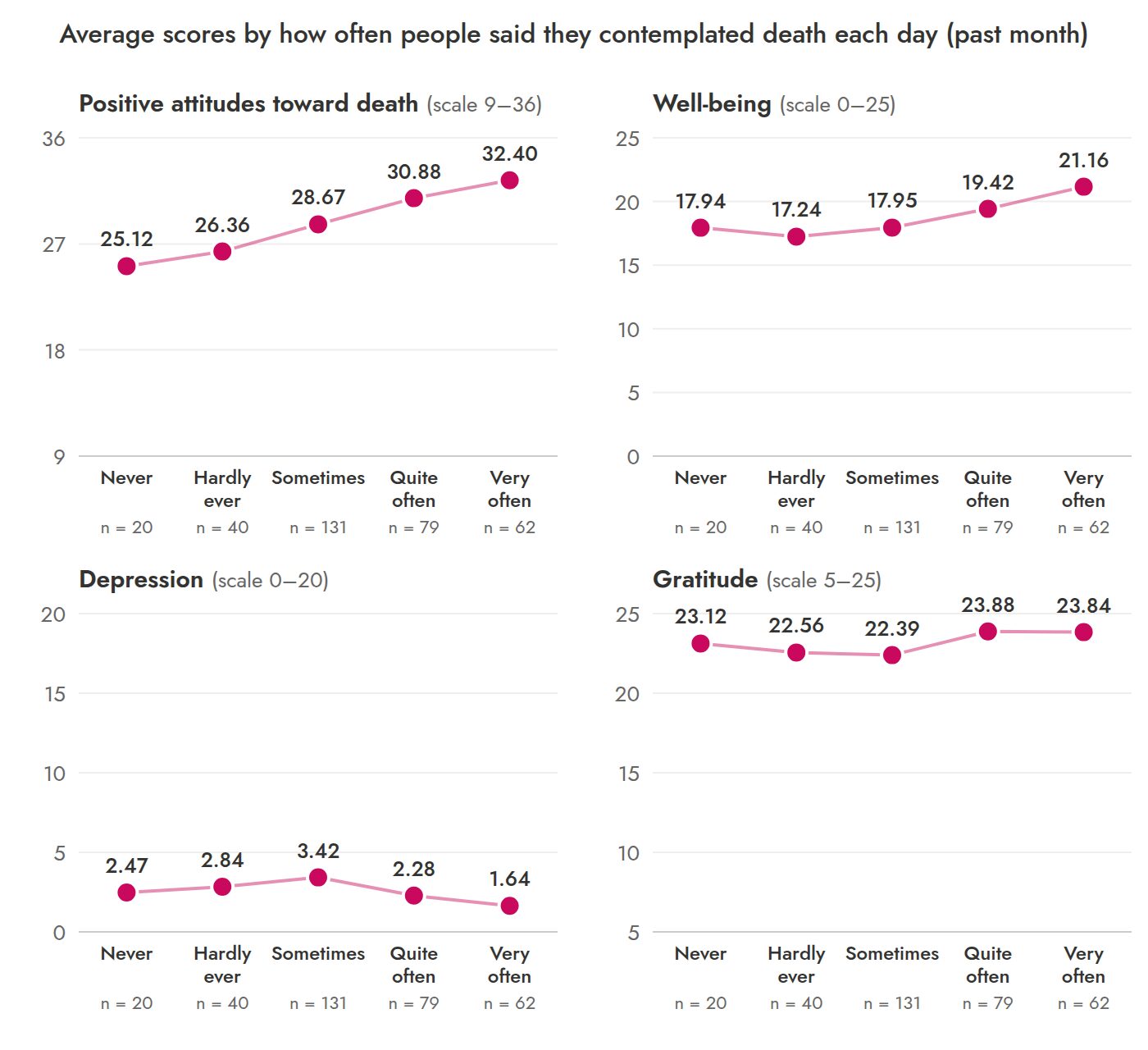
The clearest link in the data was between practice and attitude. People who said they contemplated death more often held more positive attitudes toward it (r = 0.48). Average attitude scores rose step by step across the five groups, from 25.1 among those who never practiced to 32.4 among those who practiced very often.
Both measures went with better mental health. In simple correlations, more frequent practice went with higher well-being (r = 0.28), more gratitude (r = 0.15) and less depression (r = −0.17), and more positive attitudes went with higher well-being (r = 0.39), more gratitude (r = 0.24) and less depression (r = −0.26). These are modest associations.
Once attitudes and background were taken into account, positive attitudes toward death remained significantly linked to all three outcomes, but how often people practiced did not, except for depression (p = 0.011 across the five groups; p = 0.116 for well-being and 0.226 for gratitude). The depression link was not a simple “more practice, less depression” gradient, though. In the raw averages, depression was lowest among those who practiced very often (1.64) and highest among those who practiced “sometimes” (3.42), with the 20 who never practiced in between (2.47). The paper reports a test of whether the five groups differed overall, not which groups differed from which.
The authors read this pattern as attitudes carrying the practice’s benefits: contemplating death fosters more accepting views of it, and those views support mental health. Their conclusion states it firmly:
This study highlights the central role of positive attitudes toward death, cultivated through structured contemplation practices, in enhancing psychological well-being and reducing depression among elderly Thai Buddhist meditation practitioners.
That is a reasonable hypothesis, but it is read from the data rather than tested. The abstract says the link between practice and depression weakened when attitudes were added to the analysis, yet the paper reports only the analysis with attitudes included, and no formal
mediation analysis
Mediation analysis is a statistical method that tests whether a third variable helps explain the link between a cause and an effect, for example whether a brain change helps explain why a training program altered a health marker. It estimates how much of the overall effect runs through that variable. A significant result is consistent with a causal pathway but does not prove one on its own.
More on Wikipedia
Read more in the glossary
. And because everything was measured at once, the data can’t show which way the links run. The paper’s own limitations section is more careful:
First, the cross-sectional design precludes causal inference. Longitudinal or experimental studies are needed to assess whether cultivating positive death attitudes leads to improved mental health over time, or whether the relationship is reciprocal.
Miscellaneous Interesting Takeaways
What “Positive Attitudes Toward Death” Measures
The questionnaire’s total score bundles several things together. Its items cover not fearing death, but also feeling ready to die, feeling calm at the thought of it, and believing that the soul survives death and there is a next life. One asks how often people think about their own death, which overlaps with the separate question about how often they practice death contemplation. The paper reports only the total score, so it can’t say whether practice went with less fear in particular, or with stronger religious belief, or with thinking about death more often.
The Text and Table Don’t Quite Agree
The results section says: “Well-being and gratitude scores increased progressively with more frequent death contemplation.” Table 4 shows something less tidy. Well-being dipped from the “never” group (17.94) to “hardly ever” (17.24) and only climbed from “sometimes” on. Gratitude was 23.12 among those who never practiced, slightly lower in the next two groups (22.56 and 22.39), and higher in the two most frequent (23.88 and 23.84), a spread of about 1.5 points on a scale where nearly everyone scored high. After adjustment, practice frequency wasn’t significantly linked to either.
Little Room to Move
These were mostly people who were doing well. The average depression score was 2.6 out of a possible 20, and gratitude averaged 23.2 out of 25, close to the top of the scale. With so many people at the healthy end, the study says more about differences among older adults who are mostly not depressed than about depression itself. Taken together, age, sex, education, the other background factors, attitudes and practice frequency accounted for 11% to 17% of the differences between people in each outcome.
Who Was and Wasn’t in the Study
Everyone was a Buddhist meditation practitioner recruited at temples, meditation centers or through social media, and the study set out to find people familiar with death contemplation. Only 20 people said they hadn’t practiced it in the past month, and no one who doesn’t meditate took part. So the study compares practitioners who reflect on death more often with practitioners who do so less, not people who practice with people who don’t. The paper also doesn’t describe what anyone’s practice looked like: how long a session lasted, how it was done, how many years they had practiced, or whether they had learned it from a teacher. Two of the background factors stood out in the adjusted analyses: education and living situation were linked to both gratitude and depression.
What the Study Can’t Say
- One time point: all data were collected once, so the study can’t show that practice came before the attitudes, or the attitudes before better mental health.
- Self-report only: every measure was a questionnaire. The authors note that answers may be shaped by
social desirability bias
Social desirability bias is the tendency of people answering questionnaires or interviews to present themselves in a favorable light, for example by reporting more of what they think is good and less of what they think is bad. In meditation studies it can make people who have committed to a training report more benefit than they actually experienced, which is one reason researchers look for measures that don’t rely on self-report.
More on Wikipedia
Read more in the glossary or by inaccurate recall. - One question about practice: how often people contemplated death in the past month rests on one five-point answer.
- Overlapping measures: the attitudes scale includes an item on how often people think about their own death.
- One culture: the authors note that the findings may not apply to older people of other cultures or religions, or to those without contemplative experience.
Final Reflection
This study turns to a practice that research on meditation and death has mostly passed over: recollecting death, as older Theravada Buddhists in Northern Thailand actually do it. Among 332 of them, those who said they contemplated death more often held more positive views of it, and those views went with higher well-being, more gratitude and less depression.
What it adds to this collection is a first look, from inside a living tradition, at how often practitioners recollect death and how that relates to their outlook. What it doesn’t add is a test of the practice. No one was taught or assigned it, no one was followed over time, the practice itself is captured by a single question and isn’t described, and fear of death isn’t reported separately from belief in a next life or readiness to die. Once attitudes were accounted for, how often people practiced was linked only to depression, and unevenly so.
It also sits alongside a cautionary finding. Tibetan Buddhist monastics who most firmly held the doctrine of no-self still feared the self’s end the most, a reminder that holding a doctrine about death and feeling at peace with it are not the same thing. Whether recollecting death eases that fear would take what the authors themselves call for: studies that follow people over time, and intervention studies that teach the practice. Until then, this survey shows that among older Thai Buddhists, a practice of facing death and a more positive view of it tend to go together, along with somewhat better mental health.
Citation
Glushich, A., DeMaranville, J., Wongpakaran, T., Wedding, D., & Wongpakaran, N. (2025). Death contemplation and mental well-being in elderly Thai Buddhist meditation practitioners. Narra J, 5(3), e2753. 10.52225/narra.v5i3.2753
Get the next summary by email
One or two new paper summaries every couple of weeks, sent to your inbox when they go up.
No spam, and you can unsubscribe at any time. Prefer a feed reader? Use the RSS feed.