
Background Information
For decades, psychologists have studied how people cope with knowing they will die through
Terror Management Theory
Terror management theory is a social psychology theory, proposed in 1986, that people’s awareness that they will die could cause paralyzing dread, which they manage by holding on to shared cultural beliefs that make the world feel orderly and meaningful and by building self-esteem through living up to those beliefs. Its best-known prediction, tested in many experiments, is that reminders of death make people cling more tightly to their worldview and defend it against others.
More on Wikipedia
Read more in the glossary
. Its central experiment is the
mortality salience
Mortality salience is the state of being reminded of one’s own death. In terror management research it is created on purpose, usually by asking people to write briefly about their own death, and compared with a control group asked about an unpleasant but non-lethal topic such as dental pain. Researchers then measure how the reminder shifts people’s judgments, typically after a short delay that lets thoughts of death fade from awareness.
More on Wikipedia
Read more in the glossary
manipulation: people answer a couple of questions about their own death, are distracted for a few minutes, and are then compared with people who answered questions about something neutral. Such studies have repeatedly found that death reminders make people defend their worldview and favor their own group, and in some situations become more generous, a response known as the “Scrooge effect,” after Dickens’s miser. On the theory’s account, even generosity can be a defense: living up to the values of one’s culture shores up a sense of worth against death.
A few studies have suggested that
mindfulness
Mindfulness is the psychological process of purposely bringing one’s attention to experiences occurring in the present moment without judgment. It involves maintaining awareness of thoughts, feelings, bodily sensations, and surrounding environment with an attitude of curiosity and acceptance. In meditation contexts, mindfulness practices typically involve focusing attention on the breath or body sensations as anchors to the present moment while acknowledging and releasing distracting thoughts.
More on Wikipedia
Read more in the glossary
weakens these defenses. People high in trait mindfulness reacted less defensively to death reminders and let more thoughts of death come to mind afterward, and a brief, one-time meditation removed the usual defensive effect in another set of experiments. But those practices don’t deal with death directly. This team, from universities in Rome, wanted to study people whose tradition puts death at the center of practice. They chose
Sufism
Sufism is the mystical tradition within Islam. Its practitioners, often organized in orders around a teacher, seek a direct inner experience of God through practices such as dhikr (rhythmic repetition of God’s names or short phrases), meditation, prayer and, in some orders, music and movement. Sufi writers often describe death not as an end to be feared but as a reunion with God.
More on Wikipedia
Read more in the glossary
, the mystical tradition of Islam:
Sufi thought encourages individuals to approach death not as a threat to be avoided, but as a reunion with the divine.
Almost every other study in this collection on meditation and death draws on Buddhist practice or belief, from Tibetan monastics to Insight meditators. This one offers a comparison from a different religion, in which death is contemplated as a longed-for union with God rather than as a lesson in impermanence.
The study was funded by the BIAL Foundation, and the authors declare no conflicts of interest. Its data are openly available.
What They Did
Two Persian-speaking research assistants recruited 67 volunteers in the provinces of Mazandaran and Gilan in northern Iran, through their personal contacts and by asking participants to refer others. Twelve were later excluded, nine for not completing every part and three because of technical problems, leaving 55:
- 24 Sufi practitioners (18 men), aged 19 to 84. The intended minimum was more than 1,000 hours of lifetime practice, about three years; they reported 1 to 39 years (average 15.6). One had practiced for only a year, an exception the authors made because long-term practitioners were hard to find, and say did not change the main findings.
- 31 people with no meditation experience (20 women), aged 22 to 56.
The paper doesn’t say which Sufi order or orders the practitioners belonged to, or what their practice involved day to day. Participants were told the study was about “their perspectives on life, lifestyle, and personality traits.” They first filled in questionnaires on paper about their meaning in life, life satisfaction, psychological distress and self-transcendence (a sense of spiritual connection and self-forgetfulness). Then came a session at a computer, supervised by a research assistant:
- An implicit attitude task. In this version of the
affective misattribution procedure
The affective misattribution procedure (AMP) is a test of implicit attitudes. A word or picture flashes briefly on screen, followed by an unfamiliar symbol such as a Chinese character, and people judge whether the symbol is more or less pleasant than average. Feelings about the first item tend to spill over onto the symbol even when people are told to ignore it, so the share of “pleasant” judgments after each kind of item is read as an attitude they might not report directly.
Read more in the glossary , a word flashed on screen for 75 milliseconds, followed by a Chinese character, and participants judged whether the character was more or less visually pleasant than average. Half the words were about gaining for oneself (keep, gain, earn, profit, obtain) and half about helping others (share, give, aid, favor, assistance), translated into Persian. The more often a person found a character pleasant after “giving” words than after “gaining” words, the stronger their implicit preference for others’ interests over their own, which the authors call prosocial orientation. - The death reminder. Everyone answered two open-ended questions: “Please briefly describe the emotions that the thought of your own death arouses in you,” and “Jot down, as specifically as you can, what you think will happen to you as you physically die and once you are physically dead.”
- A distraction, which doubled as a measure of feelings. Participants filled in the
State Anxiety Inventory
The State Anxiety Inventory is the half of the State-Trait Anxiety Inventory (STAI) that asks how anxious someone feels right now, rather than how anxious they tend to be in general. People rate 20 statements such as “I feel worried” from 1 (not at all) to 4 (very much so), giving a score from 20 to 80. Because it captures the moment, researchers can give it just before and just after a single session.
More on Wikipedia
Read more in the glossary and a positive and negative mood questionnaire (the PANAS). - The implicit task again.
- A word-fragment task measuring
death-thought accessibility
Death-thought accessibility is how readily thoughts of death come to mind. It is usually measured with word fragments that can be completed either as a death-related word or as a neutral one, such as SK_ _L (skull or skill), and counting the death-related completions. In terror management theory research, the count is normally compared between people given a death reminder and people given a neutral one.
Read more in the glossary . Six of 20 fragments could be completed either as a death-related word or as a neutral one. In the Persian version, for example, “_arg” could become marg (“death”) or barg (“leaf”).
Two features of this design matter for everything that follows. Unlike the classic experiment, there was no group that answered questions about a neutral topic: everyone got the death reminder. And anxiety, mood and the word fragments were measured only after the reminder, never before it. Only the implicit task was given both before and after.
One Big Result: After the Death Reminder, the Sufi Practitioners Were Less Anxious and Wrote More Death Words
After the reminder, the non-meditators reported higher anxiety than the Sufi practitioners. The analysis adjusted for age, gender, distress, life satisfaction, self-transcendence and meaning in life. Its overall test across anxiety, positive mood and negative mood together fell just short of significance (p = 0.07), and a follow-up test of anxiety alone was significant (p < 0.05). Positive mood (p = 0.57) and negative mood (p = 0.50) didn’t differ between the groups. The paper gives the groups’ anxiety averages only in a chart.
On the word fragments, the Sufi practitioners completed more of them as death words: 0.75 on average against 0.33 for the non-meditators, out of a possible 6 (p < 0.05, adjusting for age, gender, anxiety and mood). Most people in both groups wrote few or no death words. In terror management research, more death completions usually mean that thoughts of death are closer to the surface. The authors read the Sufis’ higher count as a sign that they don’t push such thoughts away, in line with the earlier findings on mindfulness.
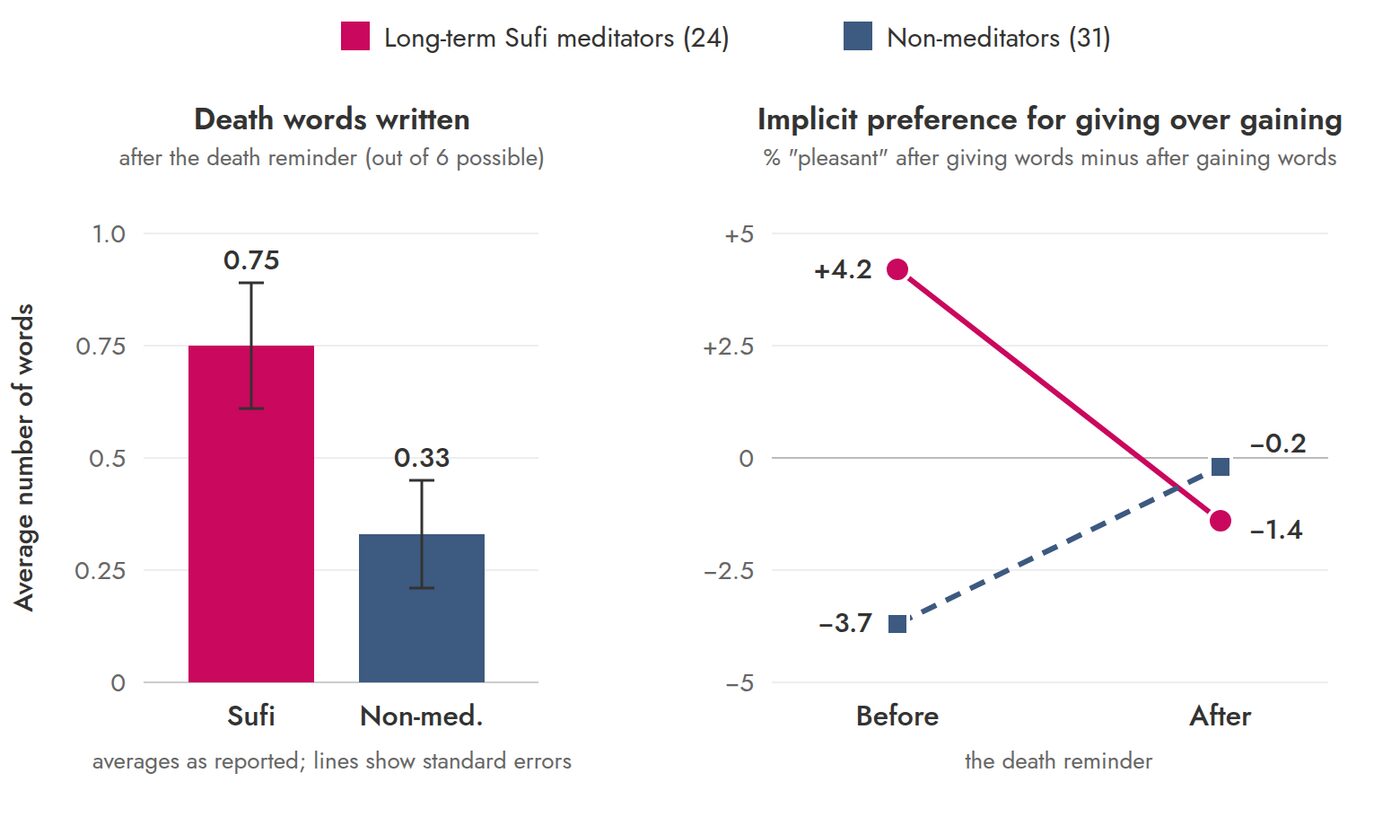
That reading is possible, but the design can’t show that the reminder caused either difference. Since anxiety and death words were measured only after the reminder, and no one received a neutral reminder, the Sufis might have been calmer, and thought about death more readily, on any day. People whose tradition asks them to think about death often may simply have it closer to mind. The authors acknowledge this:
Moreover, because death-thought accessibility was assessed only after the mortality salience manipulation, we cannot rule out the possibility that long-term meditators differ from non-meditators in the baseline accessibility of death-related thoughts.
On anxiety, one detail weighs a little against a general difference: the two groups’ psychological distress, measured beforehand, didn’t differ significantly, and the analysis adjusted for it. But distress and anxiety after the reminder were closely linked (r = 0.74), and without a measure of anxiety before the reminder, or a group with a neutral reminder, there is no way to tell how much of the gap the reminder produced.
The abstract says that following mortality reminders, non-meditators “reported higher anxiety.” That means higher than the Sufi practitioners, not higher than before the reminder, which wasn’t measured.
Miscellaneous Interesting Takeaways
The Implicit Task: A Shift in Opposite Directions, of Uncertain Meaning
This was the only measure taken both before and after the reminder. Before it, the two groups differed: the Sufi practitioners found characters pleasant 4.2 percentage points more often after “giving” words than after “gaining” words, while the non-meditators leaned slightly the other way (3.7 points less often), a significant difference. After the reminder, both groups were close to zero (Sufis −1.4, non-meditators −0.2), no longer significantly different. The change over time differed significantly between the groups (p < 0.05).
The authors read the non-meditators’ shift toward “giving” as the defensive generosity terror management theory predicts, and the Sufis’ shift away from it as a sign that they didn’t need that defense. In their discussion, though, they describe the evidence more cautiously than the results section does:
Although group differences in implicit prosocial orientation did not reach statistical significance, the observed pattern is theoretically informative.
Several things counsel caution. The differences are small, a few percentage points on a task of 100 quick judgments. Two groups that start apart and both end near zero could also reflect
regression to the mean
Regression to the mean is the tendency for unusually high or low measurements to be followed by ones closer to average, because part of any single measurement is chance. People who score as very stressed on a questionnaire one week will, on average, score a little less stressed the next, with or without treatment. In a trial, a group that happens to start out worse can therefore seem to improve more, which is one reason researchers compare against a control group and adjust for starting scores.
More on Wikipedia
Read more in the glossary
, which a group with a neutral reminder could have ruled out. The authors had made two opposite predictions for the Sufis in advance, that they would show no preference after the reminder or a preference for “gaining” words, so the result was always going to match one of them. And in their results, the Sufis’ “pleasant” judgments fell after the reminder whichever kind of word came first, more after “giving” words; after the reminder they found characters pleasant 52% of the time, against 66% for the non-meditators. The authors themselves note that participants may not have seen giving versus gaining as relevant to defending their worldview.
Longer Practice Went With Less Anxiety, Within the Sufi Group
Among the 24 Sufi practitioners, those with more years of practice reported less anxiety (r = −0.44) and less negative mood (r = −0.47) after the reminder, though not more positive mood (r = 0.24). With only 24 people, these estimates are rough. The practitioners’ ages ranged from 19 to 84, and the authors note that larger samples are needed to separate age and life experience from years of practice; the paper doesn’t report whether these correlations hold once age is taken into account. And because anxiety was measured only after the reminder, longer practice may simply go with less anxiety in general.
Meaning in Life Mattered, Self-Transcendence Didn’t
The Sufi practitioners reported more meaning in life (30.6 against 25.0 on a scale whose maximum is 35) and more self-transcendence (93.9 against 84.0) than the non-meditators. Across everyone, more meaning in life and greater life satisfaction went with less anxiety after the reminder, and greater distress with more. Self-transcendence, despite being higher among the Sufis, wasn’t related to any of the feelings measured. The anxiety comparison adjusted for all of these, but only differences that were measured can be adjusted for.
Belief or Practice?
In this study, a contemplative practice comes bundled with a set of beliefs about death, a religious community and a way of life. Sufi teaching describes death as a reunion with God, and the paper itself suggests that this “theological and emotional orientation toward mortality” may be the resource that lets practitioners face death without defensiveness. Whether any difference comes from meditation, from belief, from belonging to a community, or from whatever led people to become Sufis in the first place, a comparison like this can’t say. The non-meditators’ own religious beliefs weren’t reported.
What the Study Can’t Say
- No neutral reminder: everyone got the death reminder, so the study can’t show that any difference is about death. The authors note that the changes “might also be elicited by other emotionally salient experimental primes.”
- Measured once: anxiety, mood and death words were measured only after the reminder.
- Who took part: two groups recruited through the research assistants’ personal contacts and their referrals, differing in gender balance (the Sufis mostly men, the non-meditators mostly women), meaning in life and self-transcendence. Gender, age and these traits were adjusted for statistically, but other differences may remain.
- Small and not preregistered: 24 and 31 people, several outcomes, results near the conventional threshold, and no preregistered plan.
- Translated measures: the word-fragment task was adapted into Persian for this study, and so was the self-transcendence scale, which had no validated Persian version.
Final Reflection
This study brings a new tradition into research on meditation and death, and a sensible question: do people whose spiritual practice centers on death respond to reminders of it differently? On the surface, the answer was yes. After writing about their own death, long-term Sufi practitioners in Iran felt less anxious than non-meditators and let death words come to mind more readily.
But the design asks more of the data than they can give. With no measures before the reminder and no neutral comparison, the results show how two self-selected groups differed after thinking about death, not how thinking about death affected them. The most clearly before-and-after result, on the implicit task, is small and open to more than one reading, and the authors’ own discussion calls it non-significant.
The findings echo two others in this collection. Insight meditators showed a brain response the authors read as acceptance rather than avoidance of death, again compared with non-meditators tested separately. And Tibetan Buddhist monastics, who most firmly denied a lasting self, still feared its end the most, a reminder that holding a doctrine about death and feeling at peace with it are not the same thing. Whether a practice built around death, Sufi or Buddhist, actually changes how people face it would take a study that measures people before and after a death reminder, compares them with people given a neutral one, and ideally follows newcomers as they learn the practice. Until then, the gentler reading of this study is that long-term Sufi practitioners and non-meditators from the same region felt differently after contemplating death, for reasons that remain to be untangled.
Citation
Puvia, E., Simione, L., Gholizadeh, N., Feyzi, S., & Raffone, A. (2026). Contemplative practice and responses to mortality salience: Evidence from long-term Sufi meditators. Behavioral Sciences, 16(8), 1420. 10.3390/bs16081420
Get the next summary by email
One or two new paper summaries every couple of weeks, sent to your inbox when they go up.
No spam, and you can unsubscribe at any time. Prefer a feed reader? Use the RSS feed.