
Background Information
Terror Management Theory
Terror management theory is a social psychology theory, proposed in 1986, that people’s awareness that they will die could cause paralyzing dread, which they manage by holding on to shared cultural beliefs that make the world feel orderly and meaningful and by building self-esteem through living up to those beliefs. Its best-known prediction, tested in many experiments, is that reminders of death make people cling more tightly to their worldview and defend it against others.
More on Wikipedia
Read more in the glossary
starts from a stark idea: people know they will die, and that knowledge could be paralyzing if it weren’t managed. According to the theory, people manage it in two ways. Right after a reminder of death, they push the thought away, for instance by suppressing it or telling themselves death is far off. Once the thought has slipped out of awareness, they lean on a cultural worldview that makes life feel meaningful and on the self-esteem that comes from living up to it. Many experiments have found that after a brief reminder of death, known as
mortality salience
Mortality salience is the state of being reminded of one’s own death. In terror management research it is created on purpose, usually by asking people to write briefly about their own death, and compared with a control group asked about an unpleasant but non-lethal topic such as dental pain. Researchers then measure how the reminder shifts people’s judgments, typically after a short delay that lets thoughts of death fade from awareness.
More on Wikipedia
Read more in the glossary
, people become more favorable to those who share their beliefs, harsher toward those who threaten them, and keener to meet their culture’s standards.
This 2010 paper, by Christopher Niemiec and six colleagues at the University of Rochester and four other universities, asked whether those reactions are inevitable. Their candidate for a buffer was
mindfulness
Mindfulness is the psychological process of purposely bringing one’s attention to experiences occurring in the present moment without judgment. It involves maintaining awareness of thoughts, feelings, bodily sensations, and surrounding environment with an attitude of curiosity and acceptance. In meditation contexts, mindfulness practices typically involve focusing attention on the breath or body sensations as anchors to the present moment while acknowledging and releasing distracting thoughts.
More on Wikipedia
Read more in the glossary
, which they defined as receptive attention to what is happening in the present, simply observing it rather than filtering it through evaluations and judgments. If someone can stay with the thought of death rather than pushing it away, the authors reasoned, they might have less need for the defenses that follow:
Because mindfulness affords receptive, unbiased processing of threat, we hypothesized that trait mindfulness would moderate defensive responses to MS.
The word “trait” matters. The paper is about how mindful people say they are in daily life, not about meditation. The authors describe their seven studies as the first known to them to examine the role of mindfulness in terror management.
What They Did
All seven studies followed the same basic recipe. Undergraduates, earning extra course credit, were typically told they were taking part in a study of personality. Among the questionnaires was the Mindful Attention Awareness Scale (MAAS), 15 statements such as “I find myself doing things without paying attention”, each rated from 1 (almost always) to 6 (almost never), so that a higher score means more everyday mindfulness. The average score in each study was close to 4.
Hidden among the questionnaires was the death reminder: two open-ended prompts, “Briefly describe the emotions that the thought of [your own death] arouses in you” and “Jot down, as specifically as you can, what you think will happen to you physically as you [die] and once you [are physically dead].” A randomly chosen half of the students got the same prompts about watching television instead, or, in three studies, about dental pain, a control for simply thinking about something unpleasant. A mood questionnaire or a word-search puzzle followed, giving thoughts of death time to fade from awareness before the outcome was measured.
Each study then measured a different defensive reaction:
- Study 1 (64 Rochester students, all U.S. citizens): how much more students liked the author of a pro-U.S. essay than the author of an anti-U.S. essay, both supposedly written by foreigners living in the U.S.
- Study 2 (109 White students at George Mason University): how guilty students judged a defendant in a court case about racial discrimination at work, when the defendant was White and the plaintiff Black, or the reverse.
- Study 3 (128 Rochester students): how severe 10 wrongdoings were, such as a doctor who amputated the wrong patient’s leg, and how heavily the culprits should be punished.
- Study 4 (65 students at the University of Essex in England): how much students valued concern for others (such as forgiveness and equality) relative to power, achievement and pleasure.
- Study 5 (216 Rochester students): how appealing students found the physical side of sex relative to its emotional connection, among those who felt good about their bodies.
- Study 6 (96 Rochester students): a repeat of Study 1 with dental pain as the control, in which research assistants also timed how long students spent writing their answers.
- Study 7 (113 Rochester students): how readily thoughts of death came to mind, measured with word fragments that could be completed with a death word or a neutral one (BUR_ _ D as BURIED or BURNED), either right after the reminder or after a delay.
Mindfulness was never manipulated. Nobody was taught to meditate or asked to be mindful, and the paper doesn’t say whether any of the students meditated. The analyses asked a
moderation
Moderation analysis is a statistical method that tests whether the link between two variables changes depending on a third, called the moderator. For example, it can ask whether the link between craving and smoking is weaker in people who practice mindfulness more often. It is usually tested by adding an interaction term (the product of the two predictors) to a regression. It shows that a relationship differs between people, not why.
More on Wikipedia
Read more in the glossary
question: did the death reminder’s effect depend on how high a student scored on the MAAS? To show the answer, the authors estimated the effect for a student scoring well below the average (one standard deviation below) and for one scoring well above it (one standard deviation above). Most studies also controlled for traits that go along with mindfulness or could shape the results, such as self-esteem, neuroticism, nationalism and political views.
One Big Result: The Death Reminder Made Less Mindful Students More Defensive, but Not More Mindful Ones
Studies 1, 3 and 6 show the pattern most cleanly. Among students who scored low on mindfulness, writing about their own death made their judgments clearly more defensive than writing about television or dental pain. Among students who scored high, the death reminder made no significant difference.
- Study 1: after the death reminder, less mindful students favored the pro-U.S. author more strongly (a standardized effect of β = 0.55, p < .001); more mindful students didn’t (β = −0.05). The difference between the two held after the authors tested neuroticism, openness to experience, two kinds of self-consciousness and a tendency to reflect on oneself as alternative explanations.
- Study 3: less mindful students judged wrongdoings more harshly after the death reminder (β = 0.45, p < .001); more mindful students barely changed (β = 0.09, not significant).
- Study 6, run in spring 2008 with a dental pain control: the same as Study 1. Less mindful students favored the pro-U.S. author more (β = 0.51, p < .001), more mindful students didn’t (β = −0.05).
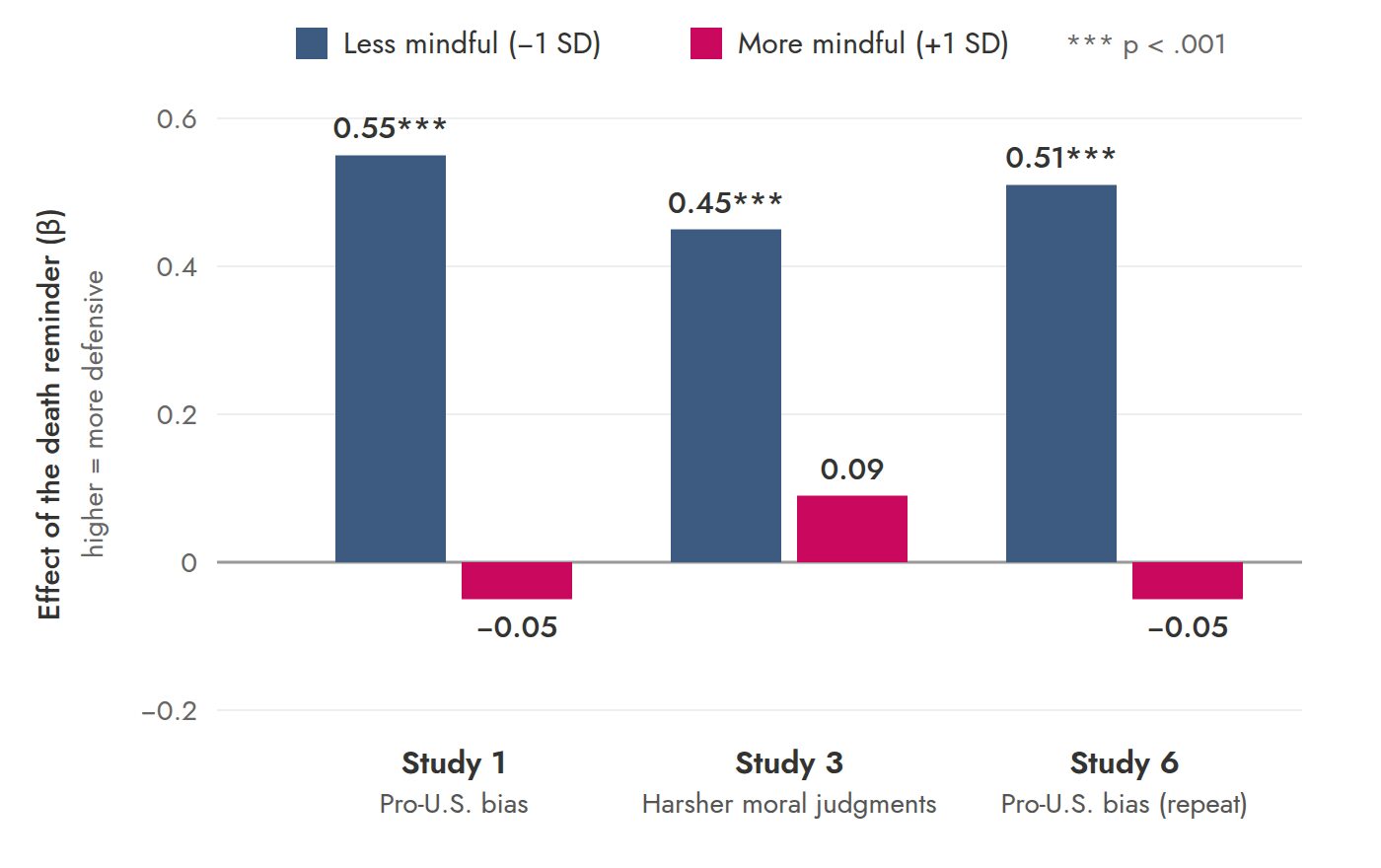
Repetition is the strength here. The same pattern appeared in three separate groups of students, with two different control topics and two different kinds of judgment. The added contribution of the mindfulness-by-reminder interaction was modest, though, explaining 3% to 9% of the variation in the outcome on top of the other predictors. And the comparison is between kinds of people, not between conditions people were put in, a point the authors make themselves in Study 1: “Because we assessed preexisting (trait) differences in mindfulness, this effect may have been due to some variable associated with mindfulness, rather than mindfulness itself.”
Miscellaneous Interesting Takeaways
Race: One Judgment Out of Three
Study 2 built on an earlier finding that after a death reminder, White students judged a White racist more leniently than a Black one. Here, among less mindful White students, the death reminder made them judge the White defendant less guilty of discrimination (β = −0.54, p < .01, about 1 point on the 11-point scale); among more mindful students it didn’t (β = 0.28, not significant). Judgments of the Black defendant didn’t change with the reminder at either level of mindfulness. But the students made three judgments of each defendant, and the pattern appeared only for guilt; for how racist the defendant was and how long his jail sentence should be, it didn’t. The authors note that the earlier study had also found its strongest effects on guilt.
Do More Mindful People Just Hold Different Values?
One explanation for the first three studies is that more mindful people don’t share the worldview being tested, so a pro-U.S. essay or a racist defendant gives them nothing to defend. Study 4 tried to give them something: values thought to go with mindfulness, such as concern for others. Less mindful students rated those values lower, relative to power, achievement and pleasure, after the death reminder (β = −0.42, p < .05), which the authors read as a turn toward self-enhancement. More mindful students didn’t change significantly (β = 0.27). The authors take this as evidence that more mindful people simply react less defensively. One caution: the estimate for more mindful students, though not significant in 65 people, leaned in the direction the authors had said would signal defense of those values.
An Unexpected Reversal
Study 5 tested a different defense, self-esteem striving, using an earlier finding that people who feel good about their bodies find the physical side of sex more appealing after a death reminder. Among students with high body esteem, the less mindful did just that (β = 0.33, p < .05). The more mindful went the other way, finding physical sex less appealing relative to emotional connection after the reminder (β = −0.44, p < .001). The authors hadn’t predicted a reversal and suggest that mindfulness may “redirect” how people manage existential terror, while arguing that it isn’t a defense in its own right. They call for more research to understand it.
More Mindful Students Spent Longer Writing About Their Death
If mindful people really stay with the thought of death rather than pushing it away, they might dwell on it longer. In Study 6, students spent an average of about five minutes (300 seconds) on the two prompts. More mindful students wrote for longer, even allowing for how many words they wrote (β = 0.27, p < .001), and under the death reminder, longer writing went with less pro-U.S. bias. In a
mediation analysis
Mediation analysis is a statistical method that tests whether a third variable helps explain the link between a cause and an effect, for example whether a brain change helps explain why a training program altered a health marker. It estimates how much of the overall effect runs through that variable. A significant result is consistent with a causal pathway but does not prove one on its own.
More on Wikipedia
Read more in the glossary
, writing time partly accounted for the link between mindfulness and lower bias, shrinking it from β = −0.39 to −0.31: a real but small share. Two details temper this. More mindful students also wrote longer about dental pain, so it wasn’t specific to death. And as the authors acknowledge, other differences could explain the longer writing, such as “carefulness, thoughtfulness, uncertainty about what to write”.
Death Thoughts Didn’t Follow the Usual Pattern
Earlier studies found that thoughts of death are hard to bring to mind right after a reminder, as people push them away, and then become more accessible after a delay, as that
suppression
Thought suppression is the deliberate attempt to push an unwanted thought out of mind. It often backfires: suppressed thoughts tend to come back more strongly later, a rebound effect. Terror management research holds that thoughts of death are pushed away right after a reminder of death and become more accessible after a delay, which experiments measure with word fragments that can be completed as either death-related or neutral words.
More on Wikipedia
Read more in the glossary
relaxes. Study 7 found that pattern only among less mindful students, who completed more fragments as death words after the delay than right away (β = 0.45, p < .05). More mindful students showed the opposite: more death words right after the reminder (β = −0.37 for the drop after the delay, p < .05). The control groups showed no such differences. The authors read the immediate rise as less suppression, but are careful about the later drop:
We interpret this latter finding as evidence that death thoughts had been adequately processed. However, it is also possible that this finding reflected delayed suppression of death thoughts among those more mindful.
Study 7 didn’t measure worldview defense, so it can’t show that less suppression is why more mindful students defended their views less.
What the Studies Can’t Show
The paper’s title speaks of mindfulness “reducing” defensive responses, and its discussion claims “strong support” for that idea, but the design shows that more mindful students reacted less defensively, not that mindfulness made them do so. The authors are clear about this in their limitations:
Another limitation is that mindfulness was not manipulated in these studies, so the findings may have been due to some other variable(s) associated with mindfulness. Experimental studies of mindfulness enhancement (inductions, interventions) are needed to determine the potential causal role of mindfulness in moderating proximal and distal defense responses.
Several alternatives were tested and ruled out, including self-esteem, neuroticism, openness, nationalism and political views, but others remain possible. All the participants were university students, mostly women, with 64 to 216 per study split among two to four conditions. Everything rested on a single mindfulness questionnaire, and every outcome but writing time was a questionnaire or rating. Study 1 also ran soon after the U.S. military launched Operation Iraqi Freedom, the 2003 invasion of Iraq, a time the authors describe as marked by heightened pro-U.S. sentiment, which is one reason they repeated it in 2008. And in Studies 1 and 6, students’ ratings of the essays themselves (as opposed to their authors) didn’t change with the death reminder at all, so that measure was set aside, as in the earlier research these studies followed.
Final Reflection
This paper opened a line of research by showing, across seven experiments and several different measures, that the classic reaction to a reminder of death, clinging more tightly to one’s own side, was concentrated among students who described themselves as less attentive to the present. Those who said they were more mindful seemed to take the reminder in their stride. The most intriguing hints concern how: they spent longer writing about their death and didn’t seem to push the thought away. Each of those tests, though, has other readings that the authors themselves name.
It is worth being clear about what this is not. No one here was studied as a meditator, trained in mindfulness, or asked to contemplate death in the way Buddhist
recollection of death
Maranasati (Pali maraṇasati, “mindfulness of death” or recollection of death) is a Buddhist meditation in which practitioners deliberately bring to mind that they will die and that death could come at any time. Early Buddhist texts describe it both as a reflection, at its most urgent the thought that death could come with the next breath, and as contemplating a corpse in stages of decay as a reminder that one’s own body will share that fate. It is traditionally meant to counter complacency and to loosen fear of and clinging to life.
More on Wikipedia
Read more in the glossary
asks. The randomized trial on this site that did train people found that six weeks of brief mindfulness or reflective practice eased fear of dying but left fear of one’s own death unchanged, and Tibetan monastics who rejected a lasting self most firmly feared its end the most. Those studies asked people about their fears; this one measured something different, the shifts in judgment that follow a reminder of death, which terror management theory holds are strongest once thoughts of death have left awareness. The closest parallel is a brain study in which experienced meditators’ automatic response to their own face held up under death-related words, unlike that of non-meditators tested in an earlier study, which its authors read as acceptance rather than denial.
The authors end by noting that mindfulness can be cultivated, which is what makes the result interesting for meditators. Whether cultivating it actually softens these defenses is the experiment this paper calls for but doesn’t run.
Citation
Niemiec, C. P., Brown, K. W., Kashdan, T. B., Cozzolino, P. J., Breen, W. E., Levesque-Bristol, C., & Ryan, R. M. (2010). Being present in the face of existential threat: The role of trait mindfulness in reducing defensive responses to mortality salience. Journal of Personality and Social Psychology, 99(2), 344–365. 10.1037/a0019388
Get the next summary by email
One or two new paper summaries every couple of weeks, sent to your inbox when they go up.
No spam, and you can unsubscribe at any time. Prefer a feed reader? Use the RSS feed.