
Background Information
Most things that are good for us are only good in the right amount. Psychologists call this pattern an
inverted U
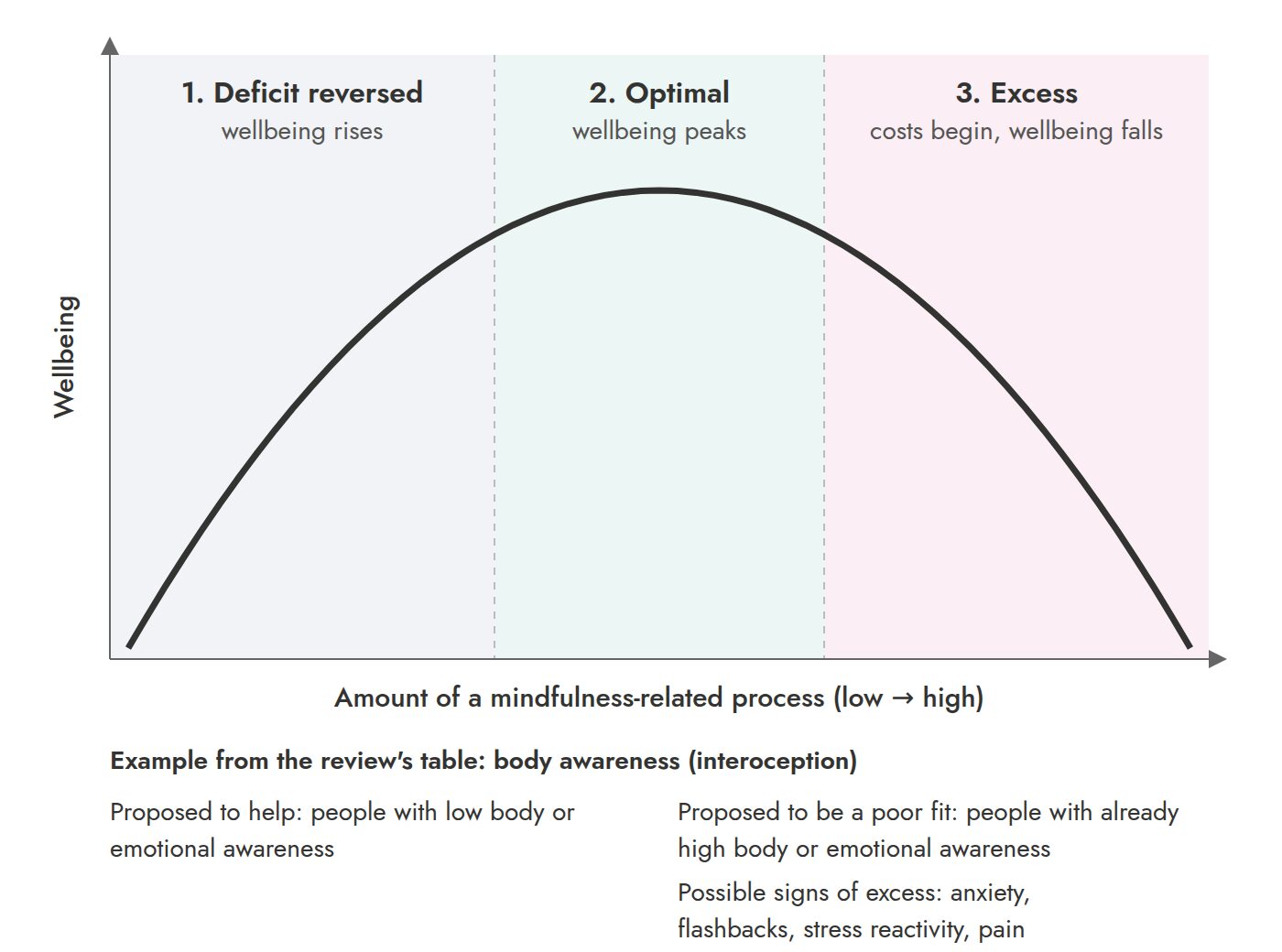
An inverted-U relationship is one in which more of something helps up to a point and then starts to hurt, so a graph of the outcome against the amount rises, peaks and falls, like an upside-down U. The classic example is the Yerkes–Dodson law, from 1908, usually summarized as performance improving with arousal up to an optimal level and then declining as arousal climbs further. Psychologists also call this a non-monotonic relationship or the too-much-of-a-good-thing effect.
More on Wikipedia
Read more in the glossary
: as you add more of something, the benefit rises, levels off and then falls. The classic example, the Yerkes–Dodson law, was described more than a century ago. In a 2011 paper, Grant and Schwartz argued that even virtues and positive traits such as curiosity and optimism follow this curve, concluded that “there is no such thing as an unmitigated good,” and suggested that
mindfulness
Mindfulness is the psychological process of purposely bringing one’s attention to experiences occurring in the present moment without judgment. It involves maintaining awareness of thoughts, feelings, bodily sensations, and surrounding environment with an attitude of curiosity and acceptance. In meditation contexts, mindfulness practices typically involve focusing attention on the breath or body sensations as anchors to the present moment while acknowledging and releasing distracting thoughts.
More on Wikipedia
Read more in the glossary
probably does too.
Willoughby Britton, of Brown University Medical School, takes up that suggestion here. Her paper, in the journal Current Opinion in Psychology, is a short review, not an experiment. It has no participants and no new data. Instead it argues a position: that the mix of positive, null and negative results in mindfulness research makes more sense if mindfulness, like almost everything else, can be too much of a good thing.
The argument draws partly on Britton’s own earlier work. She co-authored the Varieties of Contemplative Experience study, which catalogued 59 kinds of meditation-related experience in practitioners who had struggled, and two papers on meditation and sleep that she cites as evidence of a tipping point.
What They Did
Britton splits mindfulness into several mindfulness-related processes, or MRPs: paying attention to present experience, awareness of the body’s inner signals, attitudes such as non-judgment and patience, several ways of handling emotion, and the amount of meditation practice itself. For each one she makes two moves. First she shows evidence that the process is linked with better wellbeing, the rising side of the curve. Then she shows evidence that the same process can have costs “under certain conditions, for certain people or when taken too far,” the falling side.
She then proposes four things that might set where the curve turns down, sums up who she thinks is most and least likely to benefit from each process in a table, and closes with a research agenda.
This is a narrative review. Britton doesn’t say how she chose the studies she cites, doesn’t rate their quality and doesn’t combine their results. Several of her steps borrow from research outside meditation, such as studies of attention to threat in anxiety or of how often to practice gratitude. And the inverted U for mindfulness itself is the thing she proposes testing, not something the paper shows. The work was funded by the US National Institutes of Health.
One Big Result: Several Helpful Mindfulness Processes Show Signs of Turning Costly in Excess
Britton’s central claim is that at least some mindfulness processes are “likely non-monotonic”: usually beneficial, but able to turn negative for certain people, in certain conditions or at certain levels. She puts the core of the idea this way:
According to the inverted U-shaped curve principle, too-much-of-a-good-thing-type adverse effects are caused by the same mechanisms and processes that also yield benefits. This model would predict that negative effects could occur with correct practice, and would be more likely at higher doses of practice or MRP.
That last point matters. On this view, problems in meditation aren’t only a sign that someone is practicing wrongly. They can come from the very processes that make it work.
Here is the evidence she gathers for each process.
Paying attention to yourself
Directing attention to present-moment experience is central to mindfulness and has been linked with many good outcomes. But high levels of self-focused attention have also been linked with negative mood and psychological problems. On mindfulness questionnaires, people who score high on the “observing” facet, the tendency to notice one’s sensations, thoughts and feelings, have repeatedly shown worse mental health, including more depression, anxiety,
dissociation
Dissociation is a disruption in the usual integration of thoughts, feelings, perceptions, memory and sense of self. Mild forms, such as daydreaming or ‘zoning out’, are common. More marked forms include depersonalization (feeling detached from oneself), derealization (feeling that the world is unreal) and emotional numbing. Dissociation can be a response to stress or trauma and is a feature of several psychiatric conditions.
More on Wikipedia
Read more in the glossary
and substance abuse, and less tolerance of pain. A few studies, Britton notes, suggest the link with bad outcomes weakens when observing comes together with non-judgment and non-reactivity.
Body awareness and the insula
Many psychological problems go with weak
interoception
Interoception is the sense of the body’s internal state: feeling your heartbeat, breathing, hunger, warmth, tension and other sensations from inside the body. Interoceptive awareness is how much attention a person pays to these signals. Practices such as the body scan, which moves attention through the body part by part, aim to strengthen it.
More on Wikipedia
Read more in the glossary
, the sense of what is happening inside the body, and with low activity in the
insula
The insula is a region of cortex folded deep inside each side of the brain. It helps represent the body’s internal state (interoception) and is involved in emotion, empathy and compassion. Its front part, the anterior insula, comes up often in meditation research.
More on Wikipedia
Read more in the glossary
, a brain region that processes those signals. Mindfulness training is thought to help partly by strengthening both, and Britton cites evidence that it can: more body awareness after training went with greater wellbeing in
chronic pain
Chronic pain is pain that lasts longer than about three months, or beyond the time tissues normally take to heal. It can follow an injury or illness, accompany conditions such as arthritis or fibromyalgia, or have no clear cause. Because the nervous system can become more sensitive over time, chronic pain often persists even when the original damage has healed, and it is frequently accompanied by depression, poor sleep and reliance on pain medication.
More on Wikipedia
Read more in the glossary
patients, and meditation training has been linked with a larger and more active insula.
But fixing a deficit is not the same as “more is always better.” High interoception or insula activity has been linked with heightened arousal and emotional intensity, depression, anxiety, panic, traumatic flashbacks and chronic pain conditions, and Britton points out that all of these have been reported during mindfulness training. She also cites a recent trial in which breath and
body scan
The body scan is a meditation practice in which attention is moved slowly through the body, part by part, noticing whatever sensations are present without trying to change them. It is a core exercise in mindfulness programs such as MBSR.
More on Wikipedia
Read more in the glossary
training “produced the largest cortisol stress reactivity compared to other forms of meditation.” Our summary of that trial gives its full
cortisol
Cortisol is a hormone released by the adrenal glands, especially in response to stress. It mobilizes energy and helps regulate the immune system. Because it can be measured in saliva, researchers often use it to gauge how strongly someone reacts to a stressful task, such as timed mental arithmetic. Levels also follow a daily rhythm, so studies try to test everyone at the same time of day.
More on Wikipedia
Read more in the glossary
results across the practices and an untrained group.
Controlling emotion
Mindfulness training has been found to strengthen the prefrontal cortex’s control over the
amygdala
The amygdala is a pair of almond-shaped structures deep in the brain’s temporal lobes. It plays a central role in processing emotion, especially threat and fear. Meditation studies often look at how strongly the amygdala responds to emotional images, and sometimes at its size.
More on Wikipedia
Read more in the glossary
, a change linked with better
emotion regulation
Emotion regulation is the set of ways people influence which emotions they have, when they have them, and how they experience and express them. Psychologist James Gross’s process model groups the strategies into five families: choosing situations, changing situations, shifting attention (attentional deployment), changing how one thinks about a situation (reappraisal), and changing one’s response, such as suppressing an expression.
More on Wikipedia
Read more in the glossary
and less anxiety and depression. But very strong control of this kind can also go with emotional blunting and dissociation. In one of the studies she cites, mindfulness training went with a smaller amygdala response to positive pictures, but not clearly to negative ones. Britton notes that several studies have found mindfulness training can, in some people, reduce, blunt or entirely remove both positive and negative emotions.
Stepping back from experience
Decentering
Decentering is the ability to observe thoughts, feelings and memories as passing events in the mind rather than as facts about reality or fixed parts of who you are: noticing “I’m having the thought that I’ll fail” rather than simply believing “I’ll fail.” It is thought to be one of the ways mindfulness-based programs and cognitive therapies work, and is usually measured by questionnaire, for example with the Experiences Questionnaire.
Read more in the glossary
, stepping back from thoughts and feelings instead of being fused with them, is a core mindfulness skill and has been found to explain some of its benefits. Britton points out that mindfulness shares some brain and body features with dissociation, including high parasympathetic tone (the calming, rest-and-digest side of the nervous system), strong prefrontal control over the amygdala, and activity in the
inferior parietal lobule
The inferior parietal lobule (IPL) is a region on the outer surface of the parietal lobe, toward the back and side of the head. It combines information from the senses and the body and is involved in attention, language, the sense of being the one who causes one’s own actions (agency), and telling oneself apart from others.
More on Wikipedia
Read more in the glossary
, a region tied to
out-of-body experiences
An out-of-body experience (OBE) is the feeling of being located outside one’s own physical body, often seeing it from above or from across the room. OBEs are reported in deep meditation, near-death experiences, sleep paralysis and some neurological conditions, and can be triggered by stimulating the temporoparietal junction, a region that helps place the sense of self in the body.
More on Wikipedia
Read more in the glossary
and
depersonalization
Depersonalization is a dissociative experience characterized by feelings of detachment from one’s self, body, or mental processes. Individuals experiencing depersonalization may feel like an outside observer of their thoughts, feelings, or body, or they may feel as if they’re in a dream. It can occur as a temporary response to stress, as a symptom of psychiatric disorders, or as a feature of certain meditation experiences.
More on Wikipedia
Read more in the glossary
. Farb and colleagues had proposed that mindfulness may recruit this region to create its detached, observing view of oneself. That leaves an open question, which she poses directly: how do you step back “far enough but not too far”?
Turning toward the difficult
Mindfulness encourages “turning towards the difficult” rather than avoiding it, much like
exposure therapy
Exposure therapy is a psychological treatment in which a person deliberately and repeatedly faces what they fear or avoid, such as objects, situations, memories or bodily sensations, in a safe setting, so that the fear response gradually fades. It is a standard treatment for phobias and other anxiety disorders, obsessive-compulsive disorder and PTSD.
More on Wikipedia
Read more in the glossary
. That helps people whose problem is
experiential avoidance
Experiential avoidance is the attempt to avoid, suppress or escape unwanted inner experiences, such as painful thoughts, feelings, memories or bodily sensations, even when doing so backfires in the long run. High levels are linked with many forms of anxiety, depression and substance use, and loosening it is a central aim of acceptance-based therapies.
More on Wikipedia
Read more in the glossary
. But anxiety can also come from the opposite problem, an
attentional bias
An attentional bias is a tendency for attention to be drawn to certain kinds of things more than others. In addiction research it usually means that images or words linked to a drug, such as a cigarette or a pill bottle, grab a user’s attention faster or hold it longer than neutral ones. It is measured with computer tasks that time how quickly people respond to drug-related and neutral cues.
More on Wikipedia
Read more in the glossary
toward threat. Research on anxiety, not on meditation, has found that people with that bias do better when trained to look away from threat, and that training attention toward threat in people who aren’t avoidant has increased anxiety in both adults and children. Britton’s conclusion is that exposure helps or harms depending on where a person starts.
Accepting and reappraising
Mindfulness programs favor acceptance and reappraisal over distraction and suppression. Drawing on emotion research, Britton argues that no strategy is good everywhere. Accepting a situation can ease distress when nothing can be done, but accepting one you could have changed can lead to depression. She extends the same point to the mindful qualities themselves, such as non-judgment, curiosity, patience and kindness, citing Grant and Schwartz’s case that all of them can have costs when taken too far.
How much to practice
The most direct evidence concerns dose. Britton cites a review of
MBSR
Mindfulness-Based Stress Reduction (MBSR) is a program designed to help individuals cope with stress, pain, and illness. Developed by Jon Kabat-Zinn in the 1970s, it combines meditation and yoga to promote awareness and stress management. The eight-week program teaches participants to focus on the present moment non-judgmentally, enhancing their ability to manage difficulties.
More on Wikipedia
Read more in the glossary
and
MBCT
Mindfulness-based cognitive therapy (MBCT) is an 8-week group program that combines mindfulness meditation, adapted from Mindfulness-Based Stress Reduction (MBSR), with elements of cognitive behavioral therapy. It was developed to help people who have recovered from depression avoid relapse, by learning to notice and step back from patterns of negative thinking. Classes usually meet weekly, with daily meditation practice at home.
More on Wikipedia
Read more in the glossary
courses that found 25% of studies reported a significant positive link between how much people practiced (up to 45 minutes a day) and how well they did. In the other 75% the link wasn’t significant, and some studies found more practice went with worse outcomes.
Her own sleep studies found what she calls an inflection point. In people taking MBCT, small amounts of practice went with longer sleep, but as practice approached 30 minutes a day, sleep became shorter and lighter, and awakenings and brief arousals in the brain increased. Her practical conclusion:
Thus, if one is seeking to improve sleep through mindfulness meditation, limiting rather than increasing practice may be the best recommendation.
She also cites a study of long-term meditators’ sleep as showing poorer sleep, with arousal rising with lifetime practice. Our summary of that study describes how its own authors interpreted the results. And in a parallel from outside meditation, a gratitude exercise did more for wellbeing when done once a week than three times a week.
Miscellaneous Interesting Takeaways
Who Might Be Helped and Who Might Be Harmed
Britton’s table turns the argument into predictions. Each process is proposed to help people who start with too little of it and to risk harm in people who already have a lot. She notes that these indications and contraindications are hypotheses predicted by the model, while the possible signs of excess come from studies that found negative effects:
- Watching oneself: proposed to help people with low self-awareness; a poor fit for people who are already highly self-focused, or in acute stress or a health crisis. Possible signs of excess: anxiety, depression, dissociation, substance abuse, and in the chemotherapy trial described below, more symptom distress and social avoidance and lower quality of life.
- Body awareness: proposed to help those with low body or emotional awareness; a poor fit for those already high in it. Possible signs: anxiety, flashbacks, stress reactivity, pain.
- Emotional control: proposed to help people with poor emotion regulation and strong emotional reactions; a poor fit for people who are already emotionally controlled, have flat affect or tend to dissociate. Possible signs: emotional blunting, dissociation.
- Psychological distance: proposed to help people who are fused with their thoughts and feelings; a poor fit for those who already have normal to high distance or tend to dissociate. Possible signs: dissociation, depersonalization, out-of-body experiences.
- Facing what’s feared: proposed to help people high in experiential avoidance; a poor fit for people low in it or already biased toward threat. Possible signs: a bias toward threat, anxiety, depression.
Four Things That Might Move the Tipping Point
Britton suggests four influences on where benefit turns into cost: the dose of practice or of the process; a person’s starting point, with gains most likely where there is a deficit and harms most likely where levels are already high; balance, since one process may offset another (non-judgment already appears to offset observing, and she suggests that body awareness might keep decentering from tipping into dissociation, and awareness of one’s surroundings might keep exposure from becoming overwhelming); and the person and situation: how much of which process suits this person, here, given their goals.
Some Trials Already Found Worse Outcomes
In her annotated references, Britton points to randomized trials where mindfulness did worse than the comparison. In one, cancer patients undergoing chemotherapy who got brief mindfulness training, but not those who got relaxation training, had more symptom distress and social avoidance and lower quality of life. In a school trial with more than 300 students, mindfulness lessons increased anxiety for boys, and for students of both sexes with low depression or weight concerns at the start. She also notes the many unwanted effects reported in surveys of meditators, such as the quarter of respondents in one online survey who reported an unwanted effect, most often anxiety.
Why Research May Miss the Downside
Britton argues that standard research practice hides the falling side of the curve, in three ways:
- Positivity bias. Mindfulness studies over-represent positive results, while negative findings may go unpublished or be “spun,” a form of
publication bias
Publication bias arises when studies with positive or striking results are more likely to be published than studies that find nothing. A meta-analysis that pools only published studies can then overestimate how well a treatment works. Researchers check for it with tools such as funnel plots and Egger’s test, which need a reasonable number of studies to be informative.
Read more in the glossary . One review she cites found that 84.4% of 231 mindfulness trials gave no information about measuring or monitoring adverse effects, and, citing medical research, she notes that waiting for people to report problems rather than asking can underestimate them more than 20-fold. A later study led by Britton asked about specific experiences after a mindfulness course and found that one broad question missed most of the effects people went on to report. - Looking at only part of the range. If a study measures only low-to-moderate levels, a curve that rises and then falls looks like a straight line going up. Britton argues that the most widely used mindfulness questionnaire, the Mindful Attention Awareness Scale (MAAS), really measures a lack of mindfulness, so it captures only the rising side. Samples are restricted too: most trials analyze only people who finished the course, not dropouts or long-term follow-ups, and studies of expert meditators include people who still meditate, not those who stopped because it went badly, and typically exclude meditators with mental health problems.
- Averages that hide individuals. Group means can mask people who got worse. She recommends inspecting individual data, describing outliers and reasons for dropping out, reporting results in quartiles, and counting how many people improved or deteriorated by a clinically meaningful amount.
A Survey of 100,000 Adults, Read Two Ways
One of the annotated references is a US national survey of more than 100,000 adults, in which mindfulness meditators reported worse physical and mental health than non-meditators. That survey’s authors suggested that poor health leads people to meditate, or that meditation makes people more aware of symptoms. Britton remarks that they “did not consider the possibility that meditation may have a causal role in poor mental and physical health.” A one-time survey like this can’t settle which way the arrow points, as her own note acknowledges:
cross-sectional studies
A cross-sectional study measures a group of people at a single point in time. It can show which things tend to go together, but not which came first or whether one causes the other.
More on Wikipedia
Read more in the glossary
“cannot establish direction of causality.”
How Strong Is the Evidence?
The paper’s strength is its framework, not proof. Many of the links Britton cites are
correlations
A correlation measures how closely two things rise and fall together across people or over time. Pearson’s r runs from −1 to +1: values near +1 mean that people high on one measure tend to be high on the other, values near −1 mean the reverse, and values near 0 mean no straight-line relationship. A correlation alone can’t show that one thing causes the other.
More on Wikipedia
Read more in the glossary
from questionnaires or brain scans, which can’t show that mindfulness caused the harm. Several key steps, about attention to threat, acceptance and gratitude, come from research on other practices. And the clearest dose evidence, the 30-minute sleep inflection, comes from her own studies of people taking MBCT. The paper reads best as a strong case that the question deserves testing.
Final Reflection
Britton’s conclusion is that the field has studied only half of the curve:
Mindfulness researchers and program developers have recognized that reversal of deficiencies in MRPs enhance wellbeing, but have paid less attention to how excesses in these processes could also undermine wellbeing.
The idea is appealing partly because it is so ordinary. Almost nothing in psychology is good in unlimited amounts, so it would be surprising if mindfulness were the exception. The framework also turns adverse effects from an embarrassment into useful information: a null or negative result marks where a process stopped helping, or the people it didn’t suit.
What the paper doesn’t do is show where the tipping points are. Britton offers no measure of “too much” body awareness or decentering, and the table of who might be harmed has yet to be tested. Her proposal is a research agenda, and a practical one: ask about harms directly, report them, study dropouts and ex-meditators, look at individuals rather than averages, and stop assuming that more practice is always better. Her title points to a “middle way” between “not enough” and “too much of a good thing,” and the paper’s message for practitioners is that the right amount may differ from one person to the next.
Citation
Britton, W. B. (2019). Can mindfulness be too much of a good thing? The value of a middle way. Current Opinion in Psychology, 28, 159–165. 10.1016/j.copsyc.2018.12.011
Get the next summary by email
One or two new paper summaries every couple of weeks, sent to your inbox when they go up.
No spam, and you can unsubscribe at any time. Prefer a feed reader? Use the RSS feed.