
Background Information
How often do
mindfulness
Mindfulness is the psychological process of purposely bringing one’s attention to experiences occurring in the present moment without judgment. It involves maintaining awareness of thoughts, feelings, bodily sensations, and surrounding environment with an attitude of curiosity and acceptance. In meditation contexts, mindfulness practices typically involve focusing attention on the breath or body sensations as anchors to the present moment while acknowledging and releasing distracting thoughts.
More on Wikipedia
Read more in the glossary
courses do harm? Several posts on this site approach the question from different angles. Lindahl and colleagues catalogued the many kinds of difficulty Buddhist meditators can run into. Surveys of regular meditators and of US adults who had tried meditation asked how common such difficulties are. And Britton and colleagues interviewed people with depression symptoms in detail after an 8-week course.
Ruth Baer and colleagues at the University of Oxford start from a gap in the evidence. Most studies of mindfulness-based programs (MBPs) don’t report harmful outcomes at all. When they do, adverse effects are often defined narrowly, borrowing from medical research, and they tend to surface only if someone asks. The authors note that in psychotherapy, between 3% and 10% of clients consistently get worse, and they wanted to know whether rates in mindfulness programs are similar. There was also no established way of asking participants in these programs about harm.
Their study adds something the other posts on this theme don’t: a check on whether the people who say a course harmed them are the same people whose symptom questionnaires get worse.
What They Did
The team ran two small studies with the same course: Mindfulness: Finding Peace in a Frantic World, an adaptation of
mindfulness-based cognitive therapy (MBCT)
Mindfulness-based cognitive therapy (MBCT) is an 8-week group program that combines mindfulness meditation, adapted from Mindfulness-Based Stress Reduction (MBSR), with elements of cognitive behavioral therapy. It was developed to help people who have recovered from depression avoid relapse, by learning to notice and step back from patterns of negative thinking. Classes usually meet weekly, with daily meditation practice at home.
More on Wikipedia
Read more in the glossary
designed for the general population. It runs for eight weekly 90-minute group sessions, with 10–20 minutes a day of suggested home practice. Every mindfulness teacher met the UK good practice guidelines for mindfulness teachers.
Study 1: schoolteachers. The 84 teachers took the course at their own school, in groups of three to nine, to prepare for teaching a mindfulness curriculum to their pupils. The authors, who include the team behind MYRIAD, the large trial of mindfulness lessons in UK schools, drew them from a separate feasibility study of training schoolteachers to teach mindfulness. The training was free. Most were women (68 of 84), aged 25 to 59, and 91% identified as White British.
Study 2: university students. The 74 students had signed up for one of the course’s regular runs at the University of Oxford, in groups of about 30, for a fee of £65. (A version of the same course was tested at Cambridge in the Mindful Student Study.) Their teachers didn’t know which students were in the study. Their mean age was 24, and the group was more troubled than the teachers: 34% had been diagnosed with a mental health problem at some point, and 35 of the 74 started with scores indicating mild to severe distress. Sixty students answered again six weeks after the course.
Before and after the course, the teachers filled in standard questionnaires on depression (the PHQ-9) and anxiety (the GAD-7), and the students one on general psychological distress (the CORE-10). For each person, the team checked whether any change was larger than measurement error alone would explain, a
reliable change
Reliable change is a way of judging whether one person’s score on a questionnaire has changed by more than measurement error alone would explain. The threshold depends on how widely scores vary and how consistent the questionnaire is, so a smaller change could just be noise. Researchers often pair it with clinical significance, asking whether a score also crossed into or out of the range typical of people with a disorder. A reliable change shows that something changed, not what caused it.
Read more in the glossary
. Deterioration also counted as clinical if the score crossed into the clinical range.
After the course, everyone answered a short survey written for this study. It opened by noting that mindfulness practice can increase awareness of difficult thoughts, emotions and sensations. It then asked how often participants had had unpleasant experiences associated with practice during the course, and how upsetting they were. Harm was defined as being “worse off, in any way, after the course, than you would have been if you hadn’t done the course”, and participants rated how harmful the course had been. Free-text boxes invited them to describe both.
One Big Result: Two-Thirds Had Unpleasant Experiences, but 3–7% Felt Harmed
In both groups, about two-thirds reported at least one unpleasant experience associated with mindfulness practice during the course: 67% of the teachers and 66% of the students. Most people had them never or only occasionally (77% of teachers and 61% of students). Most were also mild. Among those who had any, 88% of teachers and 92% of students rated them “not at all” or “somewhat” upsetting.
Far fewer said the course had harmed them. Three teachers (about 4%) and two students (3%) rated it “somewhat” harmful just after the course, and no one chose a stronger rating. Six weeks later, four students (7%) did: three said “somewhat” and one “quite a bit”.
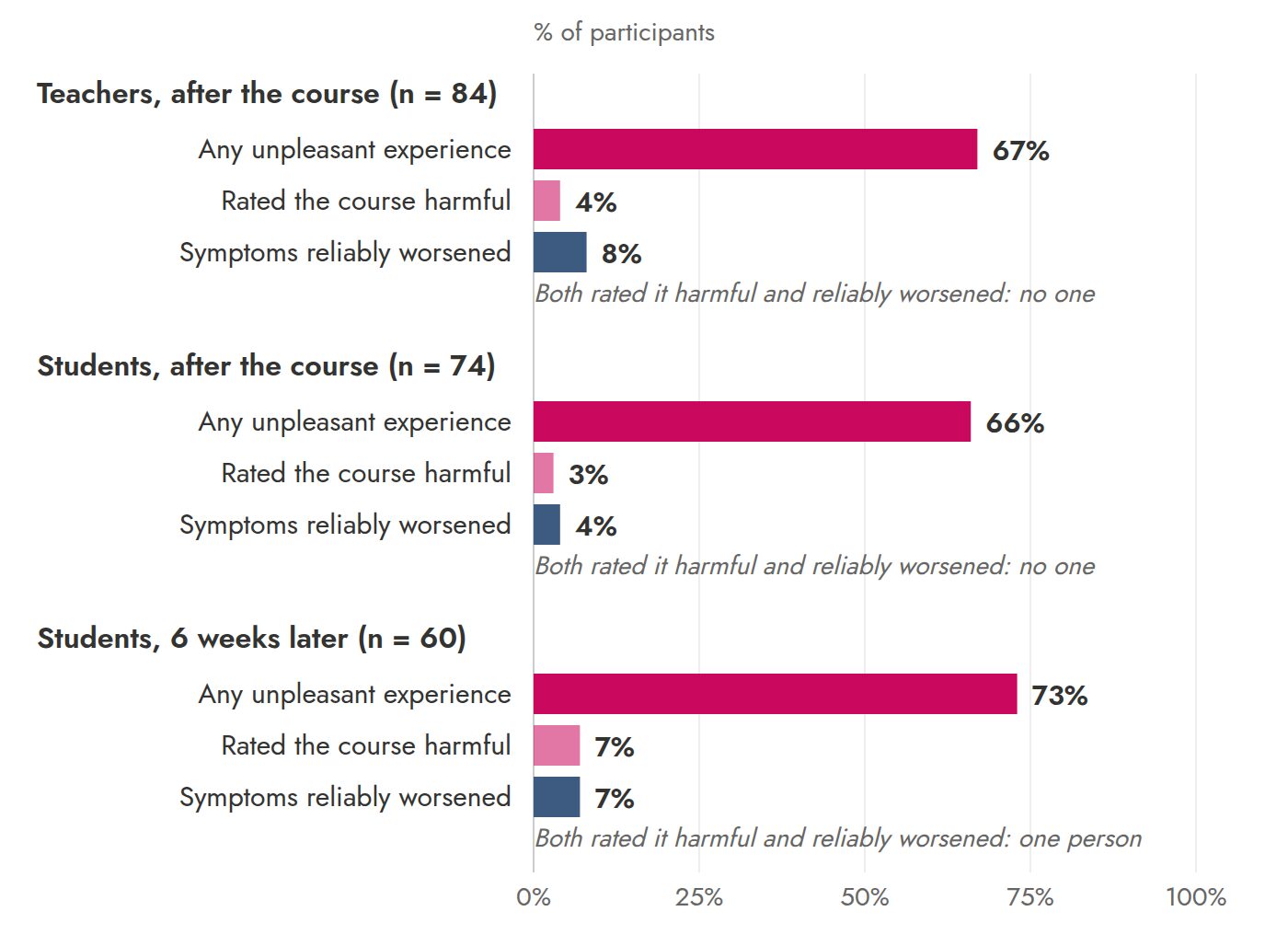
On the questionnaires, symptoms improved on average. The teachers’ anxiety and depression scores and the students’ distress scores all fell from before to after the course, and the students’ stayed lower six weeks later. But some people got worse. Seven teachers (8%) showed a reliable deterioration in anxiety or depression, though none moved into the clinical range. Among the students, 3 (4%) showed reliable and clinical deterioration after the course and 4 (7%) at follow-up.
Those rates resemble the 3–10% of psychotherapy clients who get worse, and the 0–10.6% range found in an earlier review of mindfulness programs led by Baer. But these were two different groups of people. All seven teachers whose scores worsened rated the course “not at all” harmful, as did the three students who worsened by the end of the course. Everyone who felt harmed after the course had no reliable worsening on the questionnaires. Only one person in the whole study, a student at the 6-week follow-up, both reported harm and showed reliable deterioration. The authors conclude:
Moreover, the minimal overlap between participants who reported that the MBP was harmful and those showing reliable deterioration on symptom questionnaires suggest that the experience of harm is not necessarily captured by outcome questionnaires and should be explicitly assessed in other ways.
The authors also point out that worsening scores aren’t necessarily caused by the course, since symptoms can rise for other reasons. With no control group, the study can’t say how many people’s scores would have worsened anyway.
Miscellaneous Interesting Takeaways
What the Unpleasant Experiences Were
Generally, the free-text descriptions were the kinds of difficulty mindfulness teachers expect: anxiety, frustration, painful memories, bodily pain or tension, and sleepiness. A teacher wrote, “I had feelings of anxiety when focusing on my breathing.” One student described “Panic attacks and difficulty breathing.” Others described seeing their own patterns more clearly, which could hurt. “Recognising that I struggled to say I love myself,” wrote one teacher. “It was like [I] faced up to a sad reality.”
Some people volunteered that a difficulty had turned into something useful, even though the survey asked only about unpleasant experiences. One student wrote that becoming aware of back pain led them to change how they slept and their posture, and that the pain seemed to be improving.
Feeling You’re Doing It Wrong
A recurring complaint in both groups was self-criticism about the practice itself: guilt about skipping practice, frustration at not focusing well enough, annoyance at an imperfect posture. One teacher wrote, “I also was very judgemental of myself when I did not do a practice right or forget to do the practice.” This happened even though, as the authors note, teachers often say that there are no right or wrong experiences in mindfulness meditation:
Increased awareness and open supportive discussion of the common tendency toward self-criticism may be necessary.
“Harm” Meant Different Things to Different People
Ratings and written answers didn’t always agree. Of the three teachers who rated the course “somewhat” harmful, one wrote that to call it harmful “may be a bit drastic”, and another that the difficulties “were in no way harmful or damaging”. Meanwhile two teachers who had rated the course “not at all” harmful wrote that they did experience harm. The authors suggest that some participants’ understanding of “harm” may not have been clear, and recommend interviews in future studies.
The students’ six written descriptions of harm mentioned more stress, difficult thoughts, and awareness of distress and unhappiness. Three described only negative outcomes. One student wrote that “buried” issues surfacing during the course increased their stress and led them to go home for a few days, though they expected it to be positive overall. One student had started the course while still in shock after a recent bereavement and felt it had come too soon, though they added that there had been “no long term harm whatsoever”. (The student course listed recent bereavement among its reasons not to take part, and asked people to judge for themselves whether the timing was right.) A few people sought support for difficult experiences: 7 teachers, mostly from their mindfulness teacher, and 9 students after the course and 10 at follow-up.
Who Wasn’t Asked
The survey reached only people who finished the course. Of 105 teachers assigned to it, 19 didn’t complete the post-course measures, most of whom had attended fewer than half the sessions. Most left the study for logistical reasons or because they couldn’t complete later parts of it; only one said it was because they didn’t enjoy the training. Among students, only 86 of the 296 taking the courses (29%) agreed to join the study, and 74 of them answered after the course. Anyone who left because the course went badly would be missing from these numbers.
Final Reflection
This study adds two things to the research on this theme. First, in two non-clinical groups taking a standard course, unpleasant moments were the norm and felt harm was uncommon, in line with the picture from Britton and colleagues’ detailed interviews, where most effects were brief and a minority lasted. The two studies asked very different questions of different people, so their numbers can’t be compared directly. Second, it suggests that looking for harm only through worsening questionnaire scores may miss the people who feel harmed, and flag others who don’t link their worsening to the course.
The authors’ summary is balanced:
Whilst reports of harm were rare, challenging and unpleasant experiences were common, and it seems clear that teachers and participants must understand that such experiences are likely and learn to work skillfully with them.
The limits are real. The samples were small, the participants volunteered, dropouts weren’t asked, and there was no control group, so the study can’t say whether the course caused either the unpleasant experiences or the worsening scores. The authors also wrote the survey questions for this study, using everyday words, since no established method existed. Still, its practical advice is simple: tell people before a course that difficult experiences are likely, and ask them directly about harm afterwards rather than relying on questionnaire scores.
Citation
Baer, R., Crane, C., Montero-Marin, J., Phillips, A., Taylor, L., Tickell, A., Kuyken, W., & The MYRIAD Team. (2021). Frequency of self-reported unpleasant events and harm in a mindfulness-based program in two general population samples. Mindfulness, 12(3), 763–774. 10.1007/s12671-020-01547-8
Get the next summary by email
One or two new paper summaries every couple of weeks, sent to your inbox when they go up.
No spam, and you can unsubscribe at any time. Prefer a feed reader? Use the RSS feed.