
Background Information
Most brain research on
emotion regulation
Emotion regulation is the set of ways people influence which emotions they have, when they have them, and how they experience and express them. Psychologist James Gross’s process model groups the strategies into five families: choosing situations, changing situations, shifting attention (attentional deployment), changing how one thinks about a situation (reappraisal), and changing one’s response, such as suppressing an expression.
More on Wikipedia
Read more in the glossary
has studied strategies that work through deliberate mental control: distracting yourself, or
reappraisal
Cognitive reappraisal is a way of regulating emotions by changing how you think about a situation so that it affects you differently, for example by reminding yourself that a frightening film scene is staged, or seeing a setback as a chance to learn. It is one of the most studied emotion regulation strategies and a core skill in cognitive behavioral therapy. Brain-imaging studies link it to prefrontal regions involved in deliberate, effortful control.
More on Wikipedia
Read more in the glossary
, rethinking what a situation means so that it feels less upsetting. Reappraisal is thought to rely on the prefrontal cortex, the brain’s hub for effortful control, which in turn damps down emotional areas such as the
amygdala
The amygdala is a pair of almond-shaped structures deep in the brain’s temporal lobes. It plays a central role in processing emotion, especially threat and fear. Meditation studies often look at how strongly the amygdala responds to emotional images, and sometimes at its size.
More on Wikipedia
Read more in the glossary
. The authors point out that this kind of control may not work well for everyone, including children, older adults and some patient groups, or in every situation, such as under stress. So they asked whether there are effective strategies that don’t depend on it.
Their candidate was mindful acceptance: paying attention to what is happening right now, even when it is unpleasant, and letting it be as it is, without reacting to it, judging it or trying to avoid it. Mindfulness- and acceptance-based treatments help with depression, anxiety and
chronic pain
Chronic pain is pain that lasts longer than about three months, or beyond the time tissues normally take to heal. It can follow an injury or illness, accompany conditions such as arthritis or fibromyalgia, or have no clear cause. Because the nervous system can become more sensitive over time, chronic pain often persists even when the original damage has healed, and it is frequently accompanied by depression, poor sleep and reliance on pain medication.
More on Wikipedia
Read more in the glossary
, but those are long programs with many parts. Brain studies of meditators, such as experts receiving painful heat or beginners after four days of training, involve practice built up over days or years, and people who choose to meditate may differ from those who don’t. This study asked a narrower question: what happens in the brain when people who have never meditated simply adopt an accepting attitude toward something unpleasant, in the moment?
The team, which included the developers of a brain-based measure of pain called the Neurologic Pain Signature, set out to test three things: whether acceptance makes pain and negative emotion feel less bad, whether it changes the brain’s responses to them, and whether it works through the prefrontal control regions that reappraisal relies on.
What They Did
Seventeen right-handed adults in New York City (5 women, aged 18 to 45) with no meditation experience took part. They were screened for neurological and psychiatric conditions and for psychoactive medication. One man was scanned but excluded before analysis because he said he hadn’t followed the instructions, leaving 16. The authors chose the sample size in advance, based on emotion-regulation studies of the time, which typically had 16 to 18 participants, and on their funding.
Before scanning, each person had 30 minutes of training in two instructions. REACT meant to “react naturally, whatever your response might be,” and served as the comparison. ACCEPT meant attending to the present sensation and accepting it without judging it, an instruction the authors modeled on a standard two-part definition of
mindfulness
Mindfulness is the psychological process of purposely bringing one’s attention to experiences occurring in the present moment without judgment. It involves maintaining awareness of thoughts, feelings, bodily sensations, and surrounding environment with an attitude of curiosity and acceptance. In meditation contexts, mindfulness practices typically involve focusing attention on the breath or body sensations as anchors to the present moment while acknowledging and releasing distracting thoughts.
More on Wikipedia
Read more in the glossary
and on mindfulness programs,
Acceptance and Commitment Therapy
Acceptance and commitment therapy (ACT) is a form of psychotherapy that combines mindfulness and acceptance with values-based action. Rather than trying to change or get rid of difficult thoughts and feelings, people learn to notice and make room for them, clarify what matters to them, and commit to acting on those values.
More on Wikipedia
Read more in the glossary
and Dialectical Behavior Therapy. For example:
For example, participants were told ‘if you feel a sensation of warmth on your forearm, you should simply attend to what is felt, without making any judgment of the “goodness” or “badness” of that sensation.’
People practiced on sample pictures, saying their responses aloud, and didn’t start scanning until they showed they could follow both instructions.
In the
fMRI
An fMRI (functional Magnetic Resonance Imaging) measures changes in blood flow related to neural activity in the brain, offering insights into brain function and activity patterns.
More on Wikipedia
Read more in the glossary
scanner, they saw 30 negative and 30 neutral photos from a standard research set and felt 30 painfully hot and 30 warm heat pulses on the forearm. The temperatures were set for each person beforehand: the hot ones (45–48°C) at 8 on a 10-point pain scale, the warm ones (40.5–44°C) at 2, described as non-painful warmth. Stimuli came in blocks of about a minute, each starting with a 3-second ACCEPT or REACT cue, with a colored border around the screen as a reminder throughout the block. Each stimulus lasted 8 seconds, and after a short pause, people rated how negatively they felt on an eight-point scale. Each of the five scanning runs held 24 trials.
Besides comparing brain activity region by region, the team applied the Neurologic Pain Signature (NPS), a pattern of activity spread across many brain areas that members of the team had built with machine learning (a form of
multivoxel pattern analysis
Multivoxel pattern analysis (MVPA) is a family of brain-imaging methods that look at the pattern of activity across many small points (voxels) at once, rather than at how strongly one region responds. Often with machine learning, researchers train a pattern on one set of scans to recognize a mental state, such as physical pain, then test it on new people. A pattern that works reliably is sometimes called a brain “signature” of that state.
More on Wikipedia
Read more in the glossary
) and validated in earlier studies. It responds in step with rising heat and pain reports and, in that earlier work, didn’t respond to threat cues or emotional pictures. The authors note that reappraisal had not lowered it in previous research.
One Big Result: Accepting Painful Heat Lowered a Brain Signature of Pain by About a Quarter
First, the NPS behaved as it should in this group. It responded more strongly to hot than warm heat under both instructions, picked out the hot condition in 93.75% of participants, and didn’t respond to either kind of photo. The authors treat this as a check that the scans were of good quality.
The key comparison was between the hot trials: the same temperatures, felt with an accepting attitude or reacting naturally. The NPS response was significantly lower during ACCEPT, a 26% drop (t(15) = 2.59, p = .02,
effect size
Effect size is a statistical concept that quantifies the magnitude or strength of a relationship, difference, or intervention outcome. Unlike p-values which only indicate statistical significance, effect sizes measure how meaningful a result is in practical terms. Common measures include Cohen’s d (standardized mean difference), correlation coefficients (r), and odds ratios. In meditation research, effect sizes help quantify the practical impact of different meditation practices on psychological or physiological outcomes.
More on Wikipedia
Read more in the glossary
d = 0.65). The authors note that this effect was larger than the effects of
placebos
A placebo is an inactive treatment, such as a sugar pill or a cream with no drug in it, made to look like a real one. The placebo effect is the improvement people feel after receiving it, driven by their expectations, by learning from past experiences of real treatment, and by the setting of care. Pain is especially responsive: placebo pain relief is well documented in the lab and has been linked to prefrontal brain areas and the brain’s own opioids.
More on Wikipedia
Read more in the glossary
in 19 of 20 studies in a recent review of placebo effects on the NPS.
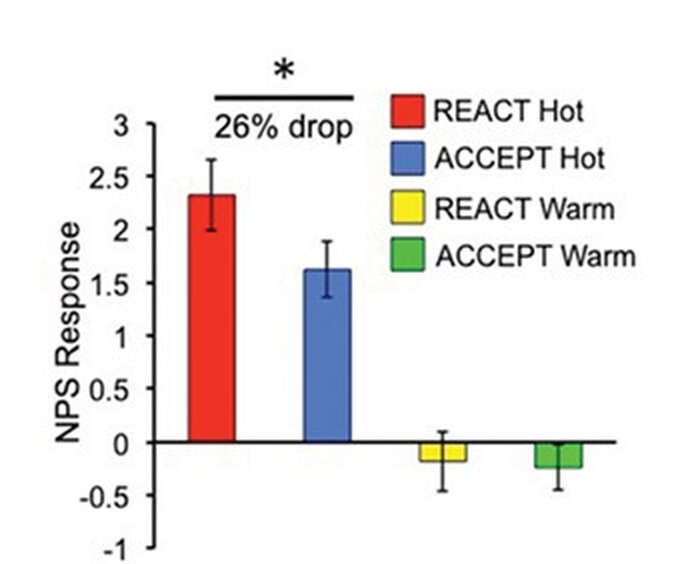
Because the NPS is read from brain activity rather than from what people say, the authors argue that acceptance changed the pain response itself, not just how people judged or reported it. They suggest acceptance might work early in the chain of events that produces an emotion, so that the same hot stimulus registers as less intense, perhaps as a passing physical sensation rather than something harmful. Another of their explanations draws on the Buddhist idea that acceptance keeps a second layer of distress from being added to the first, “the second arrow.” They offer several such explanations, and the study wasn’t designed to tell them apart.
Miscellaneous Interesting Takeaways
People Felt Less Bad About Both Pictures and Heat
As expected, negative photos and hot heat made people feel much worse than neutral photos and warm heat. Accepting lowered their ratings for both kinds of stimulus: for the photos (t(15) = 4.56, p < .001, d = 1.14) and for the heat (t(15) = 6.05, p < .001, d = 1.51), with no significant difference between the two in how much acceptance helped. The paper gives these as test statistics; its Figure 2 shows the averages, and also marks ACCEPT ratings as significantly lower for the neutral photos and warm heat.
The heat ratings used the same “how negatively do you feel” scale as the photos. So unlike other pain studies on this site, this one doesn’t separate how intense the heat felt from how unpleasant it was.
A Quieter Amygdala, but Only for Upsetting Pictures
Negative photos activated the amygdala, along with the thalamus, the
periaqueductal gray
The periaqueductal gray (PAG) is a small column of gray matter in the midbrain, surrounding the narrow canal that carries cerebrospinal fluid through the brainstem. It is a key part of the body’s built-in pain control system: signals from the PAG travel down to the spinal cord and can dampen incoming pain signals, partly through the brain’s own opioids. It is also involved in defensive responses to threat.
More on Wikipedia
Read more in the glossary
in the midbrain and the
dorsal anterior cingulate
The anterior cingulate cortex (ACC) is a strip of cortex on the inner surface of each frontal lobe, curving around the front of the corpus callosum. It is involved in monitoring conflicts and errors, regulating attention and emotion, and processing pain, and it often turns up in brain-imaging studies of meditation.
More on Wikipedia
Read more in the glossary
. Accepting reduced the right amygdala’s response to negative photos, and this was the one area that both responded to negative photos and was quieted by acceptance. The effect was specific: the same spot showed no acceptance effect for neutral photos or on hot trials. Acceptance also lowered activity in nearby midbrain areas, parts of the temporal lobe and the frontopolar cortex. A quieter right amygdala also turned up after eight weeks of mindfulness training in a small randomized trial, though there it was measured while people weren’t meditating.
Pain Areas Quieted Too
Painful heat activated a familiar set of pain-responsive regions, including the dorsal anterior cingulate, the
insula
The insula is a region of cortex folded deep inside each side of the brain. It helps represent the body’s internal state (interoception) and is involved in emotion, empathy and compassion. Its front part, the anterior insula, comes up often in meditation research.
More on Wikipedia
Read more in the glossary
, the
thalamus
The thalamus is a pair of egg-shaped structures deep in the middle of the brain that relay sensory signals (from everything except smell) and motor signals to the cerebral cortex. It acts as a gatekeeper, helping decide which information reaches the cortex, and also plays a part in regulating sleep, wakefulness and attention.
More on Wikipedia
Read more in the glossary
, the
somatosensory cortex
The somatosensory cortex is the part of the brain’s surface that receives touch, temperature, pain and body-position signals. The primary somatosensory cortex (S1), a strip behind the central groove at the top of the brain, holds a map of the body, with each body part in its own spot; the secondary somatosensory cortex (S2), lower down on each side, helps tell what a sensation is and how strong it feels.
More on Wikipedia
Read more in the glossary
and the periaqueductal gray. Accepting painful heat lowered activity in many of the same regions, and in back-of-the-brain areas such as the
posterior cingulate
The posterior cingulate cortex (PCC) is a region toward the back of the brain’s midline. It is a central hub of the default mode network and tends to be active during self-related thought and mind-wandering. Many meditation studies track PCC activity or connectivity as a window onto the DMN.
More on Wikipedia
Read more in the glossary
and
precuneus
The precuneus is a region on the inner surface of the parietal lobe, toward the back of the brain’s midline, next to the posterior cingulate cortex. Together they form a core hub of the default mode network, and the precuneus is often active during self-related thinking, memory recall and imagining one’s own point of view.
More on Wikipedia
Read more in the glossary
. The overlap between areas that responded to pain and areas that acceptance quieted included the insula, the thalamus and nearby sensory cortex.
No Sign of the Brain’s Control Regions
None of the whole-brain comparisons showed extra prefrontal activity during acceptance. The team then ran two more targeted tests. Four prefrontal
regions of interest
In brain imaging, a region of interest (ROI) is an area chosen in advance for testing, such as the amygdala or hippocampus, usually because earlier research points to it. Limiting the main test to one region means fewer statistical comparisons, so real effects there are easier to detect. The trade-off is that the test says nothing about the rest of the brain, so ROI studies often add a separate, exploratory whole-brain search.
More on Wikipedia
Read more in the glossary
that a meta-analysis by the same group had found reliably active during reappraisal, including the
dlPFC
The dorsolateral prefrontal cortex (dlPFC) is a region on the upper outer sides of the frontal lobes. It is a core part of the brain’s executive control network, supporting working memory, directing attention and regulating emotion. Stronger dlPFC activity and connectivity have been associated with lower pain, negative emotion and stress.
More on Wikipedia
Read more in the glossary
, were no more active during ACCEPT than REACT, for either photos or heat. And a
psychophysiological interaction
A psychophysiological interaction (PPI) analysis measures, with fMRI, whether two brain regions work together more or less closely in one condition than another, for example during painful heat compared with harmless warmth. It asks whether a chosen region’s activity tracks another region’s activity differently depending on the task, a kind of task-dependent functional connectivity. Like other connectivity measures, it shows coordinated activity, not a physical connection or which region drives the other.
More on Wikipedia
Read more in the glossary
analysis found no prefrontal or cingulate region that coordinated differently with the amygdala or the pain regions during acceptance.
The authors read this as evidence that acceptance works “bottom-up,” changing how a stimulus is first registered, rather than through “top-down” control. They are candid that this is an absence of evidence:
Finally, we acknowledge that we rely on a series of null results in reporting that mindful acceptance does not recruit PFC. It is possible that future analyses might reveal different findings, especially with larger samples.
A similar single-session study of smokers, on which the first author was a coauthor, also found that mindfully attending to smoking pictures quieted a craving-linked area without engaging prefrontal control regions.
What the Design Can’t Show
This was one session with 16 healthy volunteers, and the authors list the small sample as the first limitation. Everyone did both conditions, a
within-subject
In a within-subject (or repeated-measures) design, every participant takes part in all of a study’s conditions, and their results under one condition are compared with their own results under the others. Because each person serves as their own comparison, it needs fewer participants than comparing separate groups. But the order of conditions can matter, through practice, fatigue or carry-over, so researchers vary the order across participants, and people may guess what is being compared.
More on Wikipedia
Read more in the glossary
design that lets each person serve as their own comparison, but acceptance was compared only with reacting naturally, not with another strategy, so the study can’t say whether acceptance works better than, or differently from, reappraisal. The authors say a direct comparison is needed. Participants knew which instruction they were following, so their ratings could partly reflect what they thought was expected, the
demand characteristics
Demand characteristics are cues in an experiment that hint at what the researchers expect, which can lead participants to behave the way they think they are supposed to rather than how they normally would. Researchers reduce them by disguising the study’s purpose, measuring behavior unobtrusively, or using comparison conditions that seem just as plausible.
More on Wikipedia
Read more in the glossary
problem; the brain measures, especially the NPS, don’t depend on a rating, which is why the authors put weight on them. The authors also note that their version of mindful acceptance may not represent every mindfulness or acceptance practice. And the study measured only what happened during the scan: it says nothing about whether the effect lasts, grows with practice or helps people with chronic pain or emotional disorders.
Final Reflection
This study’s appeal is its simplicity. With half an hour of instruction and no meditation practice, people who adopted an accepting stance toward an upsetting photo or a painful burst of heat felt less bad, and their brains responded less in the amygdala and in pain regions. A brain pattern designed to track physical pain fell by about a quarter, and the prefrontal control regions behind reappraisal showed no sign of extra effort. The authors draw a strong conclusion:
Nevertheless, the present findings suggest that mindful acceptance is a powerful emotion-regulation strategy, that can be learned quickly, deployed effectively, and that may not depend on PFC to profoundly alter the psychological and neural consequences of negative affect and pain.
The results fit with other work on this site. Beginners who had four short lessons in meditation rated heat as less painful while meditating, and a later study from the same lab found mindfulness relieved heat pain more than a sham meditation or a placebo cream did. But “powerful” and “profoundly” are big words for a single session with 16 people, one comparison condition and a central claim, no prefrontal involvement, that rests on not finding something. The study is best read as a promising, carefully measured first look at acceptance as an in-the-moment strategy, one the authors themselves say needs a larger study and a head-to-head comparison with reappraisal.
Citation
Kober, H., Buhle, J., Weber, J., Ochsner, K. N., & Wager, T. D. (2019). Let it be: Mindful acceptance down-regulates pain and negative emotion. Social Cognitive and Affective Neuroscience, 14(11), 1147–1158. 10.1093/scan/nsz104
Get the next summary by email
One or two new paper summaries every couple of weeks, sent to your inbox when they go up.
No spam, and you can unsubscribe at any time. Prefer a feed reader? Use the RSS feed.