
Background Information
By the late 2000s, mindfulness-based therapies such as mindfulness-based stress reduction (
MBSR
Mindfulness-Based Stress Reduction (MBSR) is a program designed to help individuals cope with stress, pain, and illness. Developed by Jon Kabat-Zinn in the 1970s, it combines meditation and yoga to promote awareness and stress management. The eight-week program teaches participants to focus on the present moment non-judgmentally, enhancing their ability to manage difficulties.
More on Wikipedia
Read more in the glossary
) and mindfulness-based cognitive therapy (
MBCT
Mindfulness-based cognitive therapy (MBCT) is an 8-week group program that combines mindfulness meditation, adapted from Mindfulness-Based Stress Reduction (MBSR), with elements of cognitive behavioral therapy. It was developed to help people who have recovered from depression avoid relapse, by learning to notice and step back from patterns of negative thinking. Classes usually meet weekly, with daily meditation practice at home.
More on Wikipedia
Read more in the glossary
) had become popular in clinics and psychotherapy. Reviews of them were plentiful, but most were narrative summaries that didn’t put a number on how much the therapies helped. The authors of this review were blunt about it: “it could be argued that the field has become saturated with qualitative reviews.”
The two reviews that had focused on anxiety and depression disagreed. One, by Baer (2003), read the evidence as suggesting
mindfulness
Mindfulness is the psychological process of purposely bringing one’s attention to experiences occurring in the present moment without judgment. It involves maintaining awareness of thoughts, feelings, bodily sensations, and surrounding environment with an attitude of curiosity and acceptance. In meditation contexts, mindfulness practices typically involve focusing attention on the breath or body sensations as anchors to the present moment while acknowledging and releasing distracting thoughts.
More on Wikipedia
Read more in the glossary
therapy may help with anxiety and mood disorders. The other, by Toneatto and Nguyen (2007), concluded that it had no reliable effect on them.
Stefan Hofmann and colleagues at Boston University set out to settle the question with numbers. They noted that some programs, MBCT in particular, were designed to prevent depression from coming back rather than to treat current symptoms (a later pooled analysis of MBCT for relapse prevention looks at that use). Their question was different: how much does mindfulness-based therapy reduce symptoms of anxiety and depression that people have now, and does it help most in people diagnosed with an anxiety disorder or depression?
What They Did
The team searched three research databases (PubMed, PsycInfo and the Cochrane Library) for studies published up to April 1, 2009, and checked the reference lists of relevant papers by hand. Of 727 potentially relevant articles, 39 studies qualified. To be included, a study had to:
- test a mindfulness-based therapy, delivered in person and of roughly standard length (studies with two sessions instead of the usual eight were excluded, as were taped or internet programs);
- enroll adults aged 18 to 65 with a diagnosable psychological or medical condition;
- not combine mindfulness with
Acceptance and Commitment Therapy
Acceptance and commitment therapy (ACT) is a form of psychotherapy that combines mindfulness and acceptance with values-based action. Rather than trying to change or get rid of difficult thoughts and feelings, people learn to notice and make room for them, clarify what matters to them, and commit to acting on those values.
More on Wikipedia
Read more in the glossary or Dialectical Behavior Therapy; - measure anxiety or depressive symptoms both before and after treatment.
Crucially, a study did not need a comparison group. The 39 studies included 1,140 people who received mindfulness therapy, in groups ranging from 6 to 103 people. Cancer was the most common condition (9 studies), followed by
generalized anxiety disorder (gad)
Generalized anxiety disorder (GAD) is an anxiety disorder marked by excessive, hard-to-control worry about many everyday matters, such as health, work or family, lasting at least six months. The worry comes with physical and mental symptoms such as restlessness, tiring easily, trouble concentrating, irritability, muscle tension and poor sleep.
More on Wikipedia
Read more in the glossary
(5), depression (4), chronic fatigue syndrome, panic disorder and
fibromyalgia
Fibromyalgia is a long-term condition marked by widespread pain across the body, along with fatigue, poor sleep and problems with memory and concentration. Its cause is not fully understood; it is thought to involve heightened sensitivity to pain in the central nervous system rather than damage to muscles or joints. It is diagnosed more often in women, and treatment usually combines exercise, psychological therapies and medication.
More on Wikipedia
Read more in the glossary
(3 each),
chronic pain
Chronic pain is pain that lasts longer than about three months, or beyond the time tissues normally take to heal. It can follow an injury or illness, accompany conditions such as arthritis or fibromyalgia, or have no clear cause. Because the nervous system can become more sensitive over time, chronic pain often persists even when the original damage has healed, and it is frequently accompanied by depression, poor sleep and reliance on pain medication.
More on Wikipedia
Read more in the glossary
and
social anxiety disorder
Social anxiety disorder (SAD), also called social phobia, is an anxiety disorder marked by an intense, lasting fear of being watched, judged or embarrassed in social or performance situations. People with it often avoid such situations or endure them with great distress, and tend to focus on critical thoughts about themselves and on signs of others’ disapproval. It is one of the most common anxiety disorders and is usually treated with cognitive-behavioral therapy or medication.
More on Wikipedia
Read more in the glossary
(2 each), and single studies of conditions ranging from ADHD and binge eating disorder to heart disease, stroke and traumatic brain injury. Most programs were MBSR, MBCT or close adaptations of them.
For each study, the team measured how much anxiety and depression scores changed from before to after treatment within the mindfulness group. They expressed this as an
effect size
Effect size is a statistical concept that quantifies the magnitude or strength of a relationship, difference, or intervention outcome. Unlike p-values which only indicate statistical significance, effect sizes measure how meaningful a result is in practical terms. Common measures include Cohen’s d (standardized mean difference), correlation coefficients (r), and odds ratios. In meditation research, effect sizes help quantify the practical impact of different meditation practices on psychological or physiological outcomes.
More on Wikipedia
Read more in the glossary
called Hedges’ g, a version of Cohen’s d corrected for small samples, where 0.2 is conventionally called small, 0.5 medium and 0.8 large. Calculating a before-and-after effect size requires knowing how closely people’s scores before and after are correlated, which the studies didn’t report, so the authors assumed a value of 0.7, which they describe as conservative. They then pooled the studies in a
meta-analysis
A meta-analysis statistically combines the results of many earlier studies on the same question. Pooling the data can estimate an overall effect more precisely than any single study and show whether results agree across studies. Its conclusions are only as good as the studies it includes and how similar they are.
More on Wikipedia
Read more in the glossary
using a random-effects model, which allows for real differences between studies.
They also:
- calculated between-group effect sizes for the 16 studies that had a comparison group;
- checked for
publication bias
Publication bias arises when studies with positive or striking results are more likely to be published than studies that find nothing. A meta-analysis that pools only published studies can then overestimate how well a treatment works. Researchers check for it with tools such as funnel plots and Egger’s test, which need a reasonable number of studies to be informative.
Read more in the glossary with the Fail-Safe N The fail-safe N is an early check for publication bias in meta-analysis, proposed by the psychologist Robert Rosenthal. It estimates how many unpublished studies with an average effect of zero would have to exist to make a pooled result no longer statistically significant. A large number suggests the result can’t be explained away by studies left in file drawers, though it doesn’t show whether missing studies have inflated the size of the effect.
Read more in the glossary and Funnel Plots A funnel plot is a scatter graph used in meta-analysis to look for publication bias. Each study’s effect size is plotted against its precision, which depends mostly on its sample size. Without bias, small, imprecise studies scatter widely on both sides of the average and larger ones cluster near it, forming a symmetrical funnel. A gap on one side, typically where small studies with weak results would fall, suggests some studies are missing; the trim-and-fill method estimates how many and recalculates the average as if they had been included.
More on Wikipedia
Read more in the glossary ; - compared results across four kinds of patient: those with anxiety disorders, depression, cancer and pain;
- tested whether the effect depended on the type of program, the year of publication, the number of sessions, or the study’s quality, rated on a modified
Jadad Scale
The Jadad scale is a short checklist, published by Alejandro Jadad and colleagues in 1996, for rating the quality of reports of clinical trials. It awards up to 5 points: for describing the study as randomized and randomizing properly, for describing it as double-blind and blinding properly, and for accounting for dropouts and withdrawals. Trials of therapies such as meditation, where participants know which treatment they receive, rarely earn the blinding points.
More on Wikipedia
Read more in the glossary .
One Big Result: Symptoms Fell Moderately After Mindfulness Therapy, Most of All in People With Anxiety Disorders or Depression
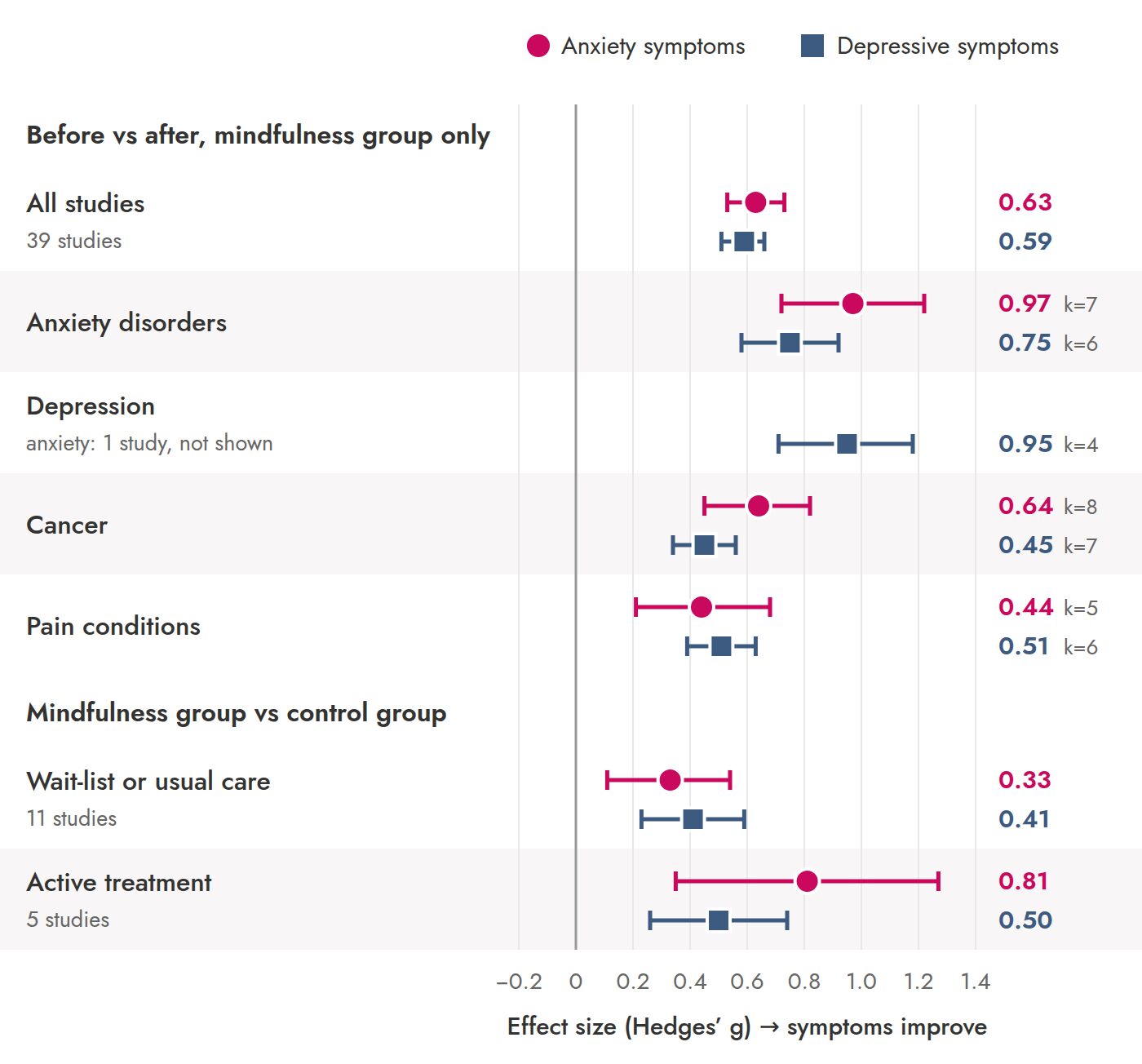
Across all 39 studies, symptoms fell by a moderate amount from before to after treatment:
- Anxiety: g = 0.63 (95%
confidence interval
A confidence interval is the range of values that a study’s data are consistent with, given the uncertainty that comes from measuring a limited sample. A 95% confidence interval for an effect of 0.30 running from 0.00 to 0.59, for example, means the true effect could plausibly be anywhere from nothing to moderate. Narrower intervals mean more precise estimates; an interval that includes zero means the study can’t rule out no effect.
More on Wikipedia
Read more in the glossary 0.53 to 0.73); - Depression: g = 0.59 (0.51 to 0.66).
The changes were larger in people being treated for the problem being measured. In seven studies of people with anxiety disorders, anxiety fell by g = 0.97 (0.72 to 1.22). In four studies of people with depression, depressive symptoms fell by g = 0.95 (0.71 to 1.18). Both are large by the usual convention. People with anxiety disorders also improved in depressive symptoms (0.75, six studies), and people with cancer (0.64 for anxiety, 0.45 for depression) and pain conditions (0.44 and 0.51) improved by smaller but still significant amounts.
The headline numbers come with a major caveat: they measure how much people changed, not how much more they changed than they would have without mindfulness therapy. Only 16 of the 39 studies had a comparison group at all. Symptoms can ease over a few months for many reasons: natural recovery, the attention and hope that come with joining any program, and
regression to the mean
Regression to the mean is the tendency for unusually high or low measurements to be followed by ones closer to average, because part of any single measurement is chance. People who score as very stressed on a questionnaire one week will, on average, score a little less stressed the next, with or without treatment. In a trial, a group that happens to start out worse can therefore seem to improve more, which is one reason researchers compare against a control group and adjust for starting scores.
More on Wikipedia
Read more in the glossary
, since people often enroll when they feel at their worst. A before-and-after design can’t separate these from the effect of the therapy itself.
The authors acknowledge this, and offer a benchmark. An earlier meta-analysis co-written by Hofmann found that psychological
placebo
A placebo is an inactive treatment, such as a sugar pill or a cream with no drug in it, made to look like a real one. The placebo effect is the improvement people feel after receiving it, driven by their expectations, by learning from past experiences of real treatment, and by the setting of care. Pain is especially responsive: placebo pain relief is well documented in the lab and has been linked to prefrontal brain areas and the brain’s own opioids.
More on Wikipedia
Read more in the glossary
conditions in anxiety disorder trials produced a before-and-after effect of g = 0.45, so they argue that mindfulness therapy’s effects are larger than what a placebo would produce. That comparison draws on different studies of different people, though, so it is a rough guide rather than a direct test.
Miscellaneous Interesting Takeaways
The Controlled Studies Gave Smaller, Less Certain Answers
In the 16 studies with a comparison group, eight compared mindfulness with a
wait-list control group
A wait-list control group is a comparison group that receives the program being studied only after the study period, so participants who are waiting can be compared with those already taking part. It controls for the passage of time and repeated testing, but not for the attention, expectations and setting that come with taking part in any program, which an active control group can address.
More on Wikipedia
Read more in the glossary
, three with treatment as usual and five with an
active control group
An active control group is a comparison group that takes part in a different program designed to be just as engaging as the one being tested. In meditation research, it might involve exercise, music, or education classes with the same time commitment, teachers, and expectations of benefit. Comparing against an active control helps separate the effects of meditation itself from the general effects of joining a course.
More on Wikipedia
Read more in the glossary
. Because people on wait-lists generally kept receiving their usual treatment, the authors pooled the wait-list and usual-care studies together. Against these 11 studies, mindfulness therapy reduced depressive symptoms by g = 0.41 (0.23 to 0.59) and anxiety by g = 0.33 (0.11 to 0.54) more than the comparison condition, smaller effects than the before-and-after figures.
The five studies with an active comparison compared mindfulness with a healing-arts program, education programs, a support group with relaxation training, and, in one study of social anxiety disorder, cognitive behavioral group therapy. Against these, mindfulness did better on both depression (g = 0.50) and anxiety (g = 0.81, with a wide confidence interval of 0.35 to 1.27). The paper doesn’t explain why the effects came out larger against active treatments than against wait-lists, and with only five studies, the estimate is imprecise.
The fail-safe N tests suggested that only one of these four controlled results, anxiety against active treatments, was robust. The authors conclude:
However, the effect sizes for the controlled studies are unreliable and should be considered preliminary.
How This Fits With Later Reviews
Two later meta-analyses on this site took the opposite approach and kept only
randomized controlled trials
A Randomized Controlled Trial is a scientific study design that randomly assigns participants to either an experimental group receiving an intervention or a control group, allowing researchers to measure the true effect of the intervention while minimizing bias.
More on Wikipedia
Read more in the glossary
, comparing people who got mindfulness therapy with people in a comparison group. Their numbers measure something different from this review’s headline figures, so they can’t be compared directly.
- Goyal and colleagues (2014) included only trials with a program matched for time and attention. Mindfulness programs improved anxiety, depression and pain slightly more than these programs, with effect sizes of 0.22 to 0.38.
- Goldberg and colleagues (2018) pooled 142 trials in people with psychiatric disorders. Mindfulness therapies beat no treatment (d = 0.55) and other therapies (d = 0.23), and did about as well as established treatments such as cognitive behavioral therapy (
CBT
Cognitive behavioral therapy (CBT) is a structured, usually short-term talk therapy that helps people notice and change unhelpful patterns of thinking and behavior. It is one of the most thoroughly tested psychological treatments and a first-line option for depression, anxiety disorders and many other conditions.
More on Wikipedia
Read more in the glossary ) and antidepressants (d = −0.004).
Read together, the three reviews tell a consistent story. People’s symptoms improve substantially over a course of mindfulness therapy, as this review shows. But people in comparison groups improve too, so mindfulness therapy’s advantage over them is smaller than the before-and-after change, and in Goldberg’s review it shrank further as the comparison got more demanding.
Hofmann and colleagues noted that conventional CBT is also quite effective for depression and anxiety disorders and called for studies that compare it directly with mindfulness therapy. Goldberg’s review later pooled 28 such comparisons with evidence-based treatments and found no difference.
Benefits Held Up at Follow-Up
Nineteen studies measured symptoms again after treatment ended, on average 27 weeks later (median 12 weeks). Compared with before treatment, anxiety was still lower by g = 0.60 (17 studies) and depression by g = 0.60 (18 studies), about the same as at the end of treatment. These are still before-and-after comparisons, without a control group. Six studies also reported
intention-to-treat analysis
An intention-to-treat analysis counts every randomized participant in the group they were assigned to, whether or not they completed or even started the treatment. It keeps the benefit of randomization, since dropping people who didn’t follow their plan can leave groups that differ in other ways, and it estimates what happens when a treatment is offered in practice rather than when it is taken exactly as intended.
More on Wikipedia
Read more in the glossary
data, counting people who dropped out; the effects were similar or larger, but the authors caution that so few studies make these results preliminary.
Starting Levels, Program Type and Number of Sessions
- Starting symptom levels. In people with medical conditions such as cancer or pain, there might be little room for improvement if they weren’t very anxious or depressed to begin with. The authors checked each study’s starting scores against standard clinical cut-offs. Studies whose participants started with elevated anxiety improved by g = 0.67, compared with 0.53 in studies whose participants didn’t; for depression the figures were 0.53 and 0.50. The authors note the elevated groups did not improve significantly more, and suggest mindfulness therapy helps across a wide range of severity.
- MBCT and MBSR. MBCT studies showed larger before-and-after effects (0.85 for depression and 0.79 for anxiety) than MBSR studies (0.49 and 0.55). The authors conclude only that both are effective. The two weren’t compared head to head: according to the paper’s table of studies, MBCT was mostly tested in people with depression or anxiety disorders, and MBSR mostly in people with cancer, pain and other medical conditions.
- Year, length and quality. The effects didn’t depend on the year a study was published, the number of treatment sessions, or study quality. Quality scores were low throughout, ranging from 0 to 3 out of 5, with a median of 1.
The authors read the similar improvement across disorders as a sign that mindfulness works on something many conditions share:
This pattern of results suggests that MBT may not be diagnosis-specific, but, instead, may address processes that occur in multiple disorders by changing a range of emotional and evaluative dimensions that underlie general aspects of wellbeing.
Checks for Publication Bias
The fail-safe N for the overall results was very large: 4,150 unpublished studies with no effect would have been needed to make the anxiety result non-significant, and 4,302 for depression. The funnel plots told a more modest story. The trim-and-fill method estimated that 7 studies were missing from the anxiety analysis and 10 from the depression analysis, and adding them lowered the estimates from 0.63 to 0.51 for anxiety and from 0.59 to 0.50 for depression. The authors concluded the before-and-after estimates were unbiased; the adjusted figures show the effects remained moderate, if a little smaller.
The Authors Expected Less
Meta-analyses can be swayed by what their authors expect to find, so the team stated their prior view:
At the outset of our review, we were rather critical toward the efficacy of MBT. We expressed our personal view in an earlier theoretical article (Hofmann & Asmundson, 2008) and were fully prepared to report non-significant or only small effects of MBT. We were surprised to find these effects to be rather robust and strong.
They also note that their conclusions depend on their selection criteria, which were deliberately broad. Including studies without control groups and studies of many different conditions let them use almost all of the research available, at the cost of studies that varied widely in design and quality.
Final Reflection
This review was one of the first to put numbers on what mindfulness-based therapy does for anxiety and depression, and its headline finding is clear: across 39 studies, people’s anxiety and depressive symptoms fell by a moderate amount over a course of mindfulness therapy, by a large amount in people with anxiety disorders or depression, and the gains held up for the few months most studies followed people. The authors argued that it showed the earlier conclusion that mindfulness had no reliable effect on these symptoms was premature.
The figures need careful reading, though. They describe how much people improved, not how much of that improvement was due to mindfulness. In the minority of studies with a comparison group, the effects were smaller, and the authors themselves called those results preliminary and ended by calling for randomized controlled trials to establish the therapy’s efficacy. The many trials that followed, pooled by Goyal and Goldberg, largely bore out the direction of this review’s findings, with a more modest size: mindfulness therapy helps with anxiety and depression, beats doing nothing and matches established treatments, but its advantage over a comparison group is smaller than the before-and-after improvement seen here would suggest.
Citation
Hofmann, S. G., Sawyer, A. T., Witt, A. A., & Oh, D. (2010). The effect of mindfulness-based therapy on anxiety and depression: A meta-analytic review. Journal of Consulting and Clinical Psychology, 78(2), 169–183. 10.1037/a0018555
Get the next summary by email
One or two new paper summaries every couple of weeks, sent to your inbox when they go up.
No spam, and you can unsubscribe at any time. Prefer a feed reader? Use the RSS feed.